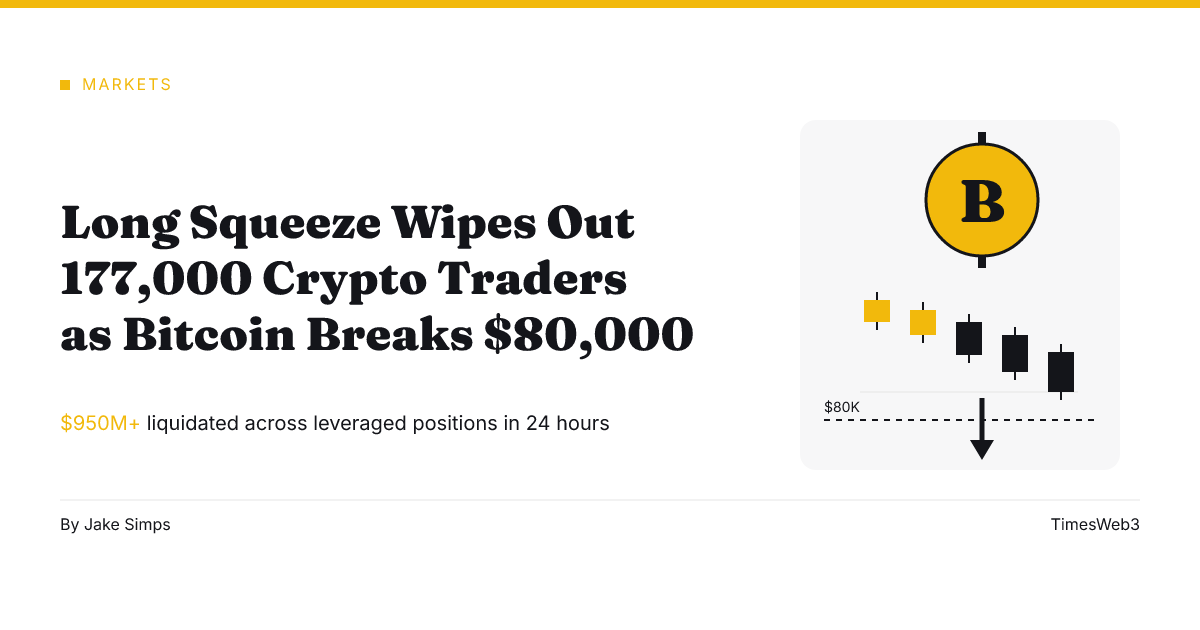
Nearly 180,000 leveraged crypto traders had their positions force-closed in a single day after a hotter than forecast inflation report reset bets on the Federal Reserve’s next move. The scale of the unwind, split roughly nine-to-one between longs and shorts, shows how much of the recent rally in digital assets was built on borrowed money rather than spot buying.
Key Takeaways
- Liquidations totaled $948.22 million across 177,440 traders in 24 hours, with longs making up 90.6% ($858.96 million), according to Decrypt, citing CoinGlass.
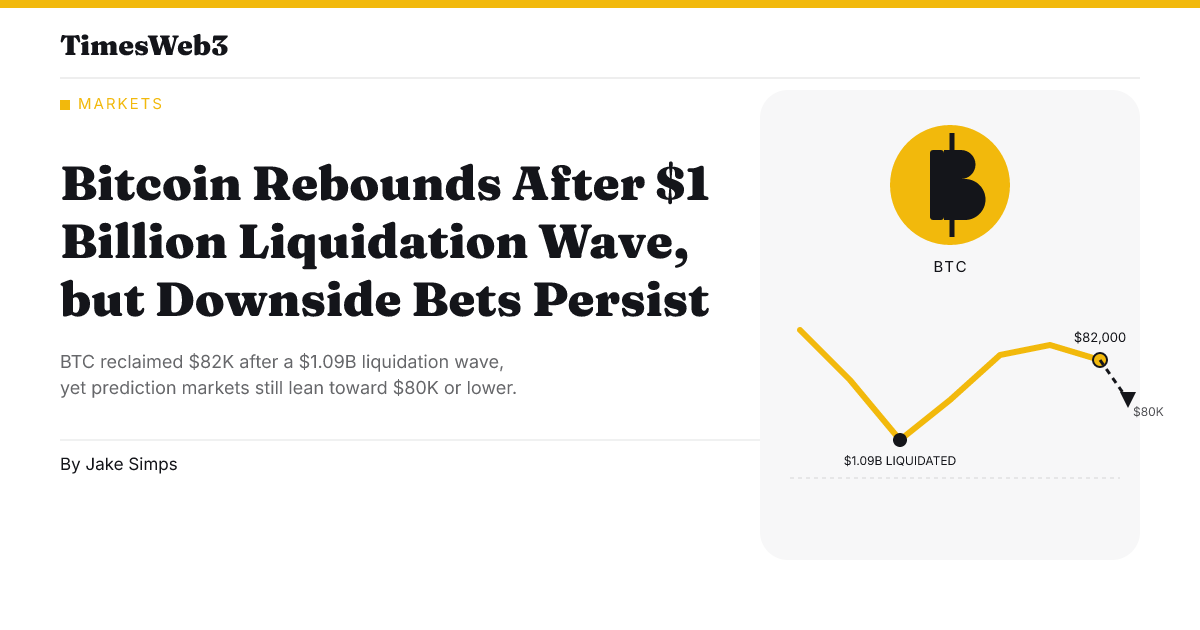
- Bitcoin broke below $80,000 for the first time in over a month before recovering to roughly $81,000-$82,000; Ethereum fell as much as 6.4% to around $2,350-$2,365.
- September CPI came in at 3.7% year over year versus a 3.6% forecast, and the Producer Price Index jumped 6.3% versus a 5.5% forecast, reviving Fed rate-hike bets.
- Bitcoin is now trading about 2% below the average cost basis of U.S. spot ETF holders, near $82,300, putting those buyers underwater again.
- The Fed’s rate decision lands October 28, followed by core PCE data on October 29 and October payrolls on November 6.
The Numbers Behind the Squeeze
CoinGlass data cited by Decrypt put total liquidations at $948.22 million over 24 hours, the third-heaviest day for long liquidations in 90 days, behind October 8 and August 22. Ethereum led individual assets at $282.03 million, with Bitcoin just behind at a little over $200 million. The largest single order was a $12.03 million Bitcoin long on Binance, closed out at $80,208.96.
CoinDesk’s AI Desk reported a similar breakdown, with Binance accounting for $515.12 million of the total, Hyperliquid $141.14 million and Bybit $101.12 million, and put the crypto market cap down 2.7% to $2.81 trillion while trading volume jumped 49% to $111 billion. Cryptoadventure logged a slightly lower figure, $942.1 million, with $863.3 million (more than 91%) in longs, and noted a single hour overnight accounted for roughly $489.4 million of the damage.
CoinDesk.com measured a narrower slice, bitcoin and ether futures alone, at $483 million during Asian morning hours, with ether contracts taking $286 million against $197 million for bitcoin. That outlet noted ether’s futures market is smaller than bitcoin’s, about $30 billion in open contracts versus $52 billion, yet still absorbed more liquidation volume.
What Triggered It
The selloff traces to back-to-back inflation prints. September’s Consumer Price Index rose 3.7% year over year against a 3.6% forecast, with core inflation at 2.6% versus a 2.5% estimate, according to Decrypt and Cryptoadventure. Cryptoadventure added detail from the Bureau of Labor Statistics: consumer prices rose 0.6% monthly, up from 0.4% in August, with gasoline up 9.1% for the month and energy costs up 5.2%, gasoline inflation reaching 34.2% annually.
A day later, the Producer Price Index rose 6.3% annually versus a 5.5% forecast. Decrypt linked much of the pressure to Brent crude trading near $104 a barrel, about 70% above a year ago, amid the war between the U.S. and Iran, which feeds into fuel, shipping and transport costs.
Hotter inflation shifts the calculus for leveraged positions directly. It pushes the Fed toward higher rates, which lifts Treasury yields and makes a roughly 5% risk-free return harder to pass up over a leveraged crypto bet, while a stronger dollar and pricier borrowing drain the cheap money that funds those trades, Decrypt reported.
Price Action and Reactions
Bitcoin dropped as low as $79,711 intraday before buyers pushed it back near $80,925, according to Decrypt’s chart data. The break came below $81,603, described as the strongest upper support from Bitcoin’s August-to-October rally that ran from $62,763 to $87,422. The Relative Strength Index fell to about 44. A daily close back above $81,603 would reopen a path to $84,245 and the $87,422 swing high; losing $80,286 would expose $78,002 and then $75,092 as the next supports.
Ethereum and XRP each fell close to 5% per Decrypt, while CoinDesk.com put ether’s drop at more than 6% to about $2,350 and XRP and Solana both down around 5%, with dogecoin off roughly 6%. Zcash’s decline was reported differently across outlets: Decrypt said almost 10%, while CoinDesk.com put ZEC’s loss at about 13% on $19 million in futures liquidations.
Iliya Kalchev, an analyst at Nexo, told Decrypt the move reflects a broader risk-off shift rather than a crypto-specific event, pointing to falling stocks and copper, rising gold, and South Korea’s Kospi down about 8%. He said Bitcoin is now roughly 2% below the average cost basis of U.S. spot ETF holders, near $82,300, after closing above that level on 21 of the last 24 trading days since September 21, which puts those buyers underwater again. Kalchev said a sustained rebound needs ETF flows to turn consistently positive after $681 million in outflows last week (against one $177 million inflow day), easing of long-term holder selling, and, in his words, a Fed path that “stops at one 25 basis point hike.”
What to Watch
The Federal Reserve announces its rate decision on October 28, with core PCE inflation data following on October 29 and October payrolls due November 6. Those releases will shape whether Treasury yields keep climbing or ease, a dynamic Decrypt’s sourcing ties directly to leveraged positioning in crypto. Bitcoin’s reaction to the $81,603 level and the $80,286 support band remains the near-term technical marker analysts are watching for signs of whether the selling has run its course.
Sources
- Decrypt: Bitcoin Whipsaws as Crypto Liquidations Near $1 Billion
- CoinDesk: Nearly $1 billion in crypto bets liquidated as bitcoin, ether and XRP slide
- CoinDesk AI Desk: Crypto markets tumble as inflation data triggers $1 billion in liquidations
- Cryptoadventure: Bitcoin and Ethereum Plunge as Hot U.S. CPI Sparks Nearly $1 Billion in Crypto Liquidations