Money left crypto funds this week, and the trigger was a data release, not an exchange event
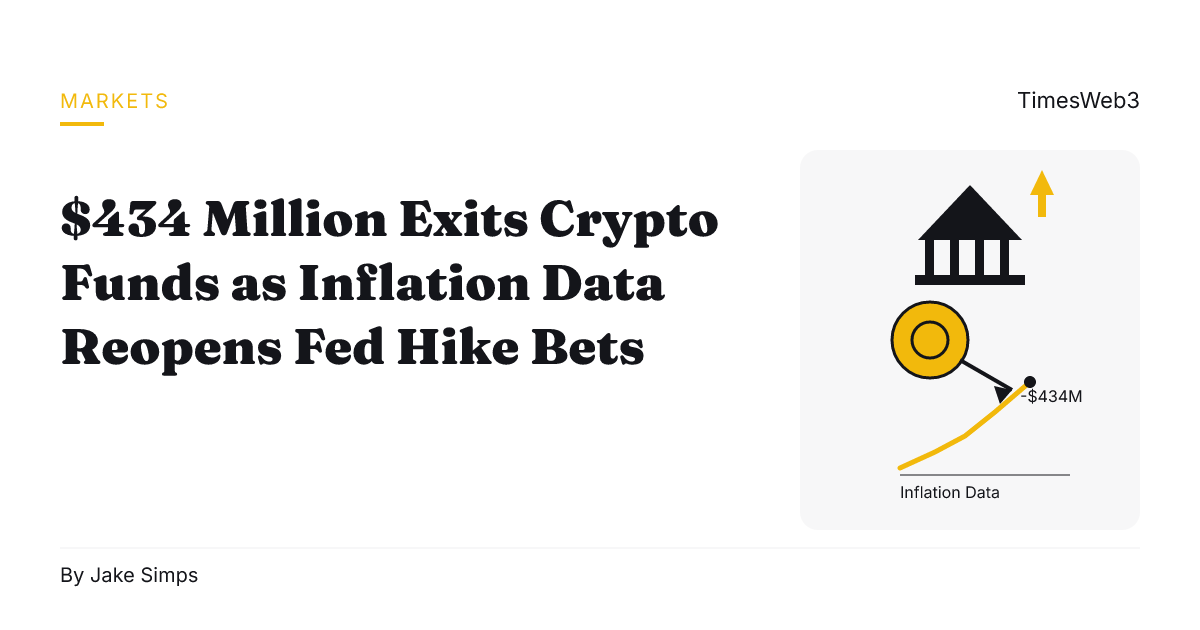
Global digital asset investment products posted $434 million in net outflows for the week through October 16, according to CoinShares. The firm ties the move to two U.S. economic reports released days earlier: September’s inflation print and September’s retail sales figures, both of which came in above forecast and pushed traders to price in a longer run of high interest rates.
The outflow marks a swing in direction. CoinNess describes the week as a shift from net inflows to net outflows, framing the move as a sentiment change rather than a one-off redemption.
Key Takeaways
- CoinShares reported $434 million in net outflows from global crypto investment products for the week through October 16.
- September CPI rose 3.7% year-over-year (forecast: 3.6%) and 0.6% month-over-month, with gasoline prices up 9.1% in the month.
- September retail sales rose 0.8% versus a 0.3% forecast, but ex-gasoline sales growth slowed to 0.2% from August’s 1.0%.
- Rate-hike odds diverge by source: Polymarket put a quarter-point October hike at 25% on October 15, while CME FedWatch put it at 17.2%, per CryptoBriefing.
- CoinShares calls Bitcoin’s near-term setup a “data-driven range rather than a trend,” not a confirmed downtrend.
The inflation and spending numbers behind the move
September’s Consumer Price Index rose 3.7% annually, above the 3.6% consensus, and 0.6% monthly, up from August’s 3.4% annual rate. Gasoline prices climbed 9.1% for the month and accounted for more than half of the headline increase, per Bureau of Labor Statistics data released October 14. The broader energy category rose 5.2% monthly and 20.4% annually. Shelter costs rose 0.4%, and food prices held flat.
Core CPI, which strips out food and energy, rose 0.3% monthly and 2.6% annually, up from 2.4% in August. CoinShares reads that as evidence that price pressure isn’t confined to fuel costs.
Retail sales added to the picture. The Census Bureau reported September retail and food services sales at $745 billion, up 0.8% monthly against a forecast near 0.3%. August’s gain was revised up to 1.3% from 1.1%. Annual retail sales growth came in at 6.3%, and the July-through-September quarter ran 5.5% above the same period a year earlier.
Strip out gasoline, though, and the picture softens. Gasoline station sales rose 6.4% in September, and excluding that category, monthly retail sales growth slowed to 0.2%, down from 1.0% in August. CoinShares flags that the headline retail figure isn’t inflation-adjusted, so part of the 0.8% gain reflects higher prices paid rather than higher volumes bought. The firm also warns that sustained energy costs could crimp spending elsewhere later in the year.
Rate-hike odds move, but trackers don’t agree on the size
The Federal Reserve raised its benchmark rate by 25 basis points in September, to a range of 3.75% to 4.00%. The October decision is still pending, and prediction markets diverge on where it lands.
CoinShares cited Polymarket data from October 15 putting the probability of no change at the October meeting around 75%, with 25% odds on a quarter-point hike. CryptoBriefing cites a different source, the CME FedWatch Tool, putting the no-change probability at 82.8% and hike odds at 17.2% for that same meeting. Both trackers point the same direction: traders still favor a pause in October but see the odds of a later-2026 hike building.
New York Fed President John Williams added to that view on October 13, saying another rate increase could be appropriate before year-end, while not signaling the same need heading into 2027, according to crypto.news. His comments are one official’s assessment, not a Federal Open Market Committee decision.
Bitcoin’s price reaction looks different depending on which snapshot you read
Coverage of Bitcoin’s price action over the same stretch doesn’t line up across outlets. Crypto.news reports Bitcoin fell below $82,000 after the October 14 CPI release, trading near $81,900 after an earlier daily high above $84,100, with $79,664 flagged as a nearby support level. The same outlet notes a further move to near $81,500 on October 15, down about 3.6% over 24 hours, coinciding with a producer price report showing wholesale prices up 1.3% monthly and 6.3% annually, the largest monthly PPI gain since March 2022.
CryptoBriefing, reporting later on October 16, describes Bitcoin trading near $83,000 and up more than 2% over the prior 24 hours. The gap reflects different timestamps rather than a contradiction: both outlets are describing a market moving in a range, which matches CoinShares’ own framing of current conditions as a “data-driven range rather than a trend” rather than a confirmed downturn.
CoinShares said a more supportive setup for crypto would need evidence of cooling inflation or softer economic activity, which would ease pressure for further tightening. Without that shift, the firm said stronger data could keep rate expectations elevated and produce more swings across digital assets. Separately, ViaBTC chief analyst Jeff Ko and Bitget Wallet research lead Lacie Zhang have tied their own October scenarios to institutional demand, Treasury yields and the Fed’s policy path, according to crypto.news.
What to Watch
The remaining October economic calendar includes the first estimate of third-quarter U.S. GDP and the September Personal Consumption Expenditures report, both due later in the month, per crypto.news. Those releases, along with the Fed’s pending October rate decision, are the next data points CoinShares expects to move rate expectations and, by extension, crypto fund flows.
Sources
- crypto.news: CoinShares reports $434M crypto fund outflows after hot U.S. CPI
- CryptoBriefing: Bitcoin outflows rise as resilient US economy complicates Fed policy: CoinShares
- SquawkNews: Digital asset funds see $434 million in weekly outflows, CoinShares reports
- CoinNess: CoinShares says crypto investment products saw $434M in net outflows last week