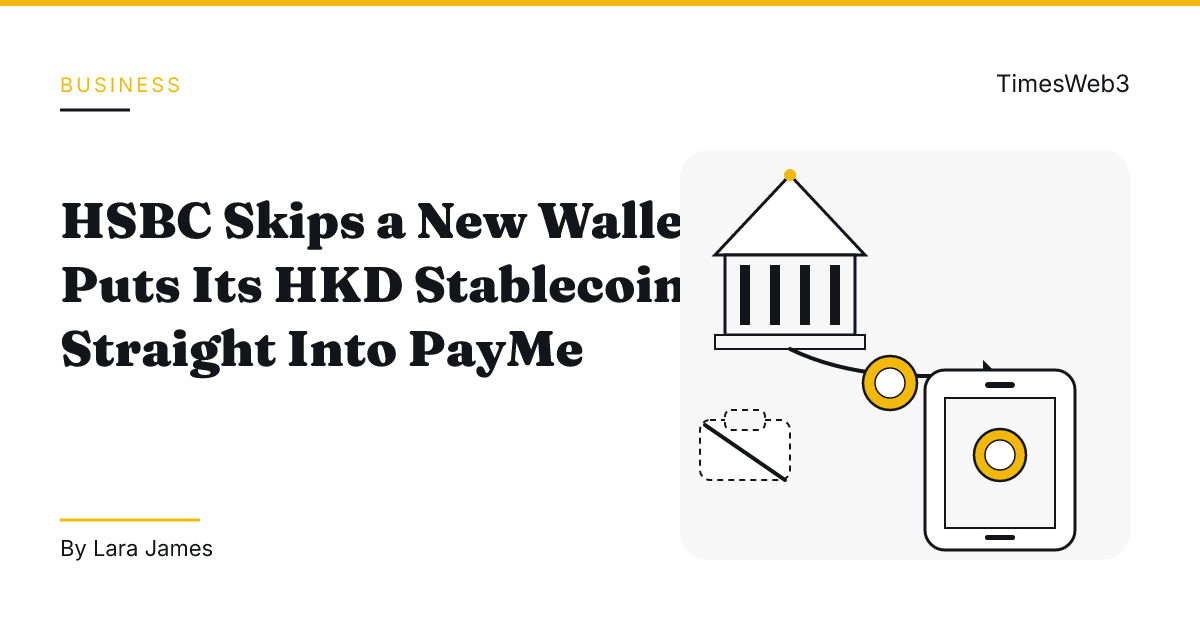
HSBC just made a stablecoin look like a feature update instead of a new product. On October 23, the bank switched on RedCoin, a Hong Kong dollar stablecoin regulated by the Hong Kong Monetary Authority (HKMA), inside its existing PayMe app, according to FinCrunch and IBTimes Hong Kong. No new account, no minimum balance, no separate wallet to learn: PayMe’s more than 3.3 million users can activate a stablecoin wallet in phases over the following days, using the same interface they already have.
That distribution model is the story. Instead of asking consumers to open a crypto account, HSBC is routing a blockchain-based token through a payments app Hong Kong residents already carry, at a moment when banks are racing to decide whether stablecoins are a back-office settlement tool or a consumer product.
Key Takeaways
- HSBC launched RedCoin (ticker RCHKD), a Hong Kong dollar stablecoin licensed by the HKMA, on PayMe on October 23, with more than 3.3 million PayMe users able to activate a wallet in phases.
- RedCoin works for peer-to-peer transfers and payments at more than 100,000 merchants, with no new account or minimum balance required; limits match PayMe’s existing Hong Kong dollar wallet.
- RedCoin is Hong Kong’s second HKMA-licensed stablecoin, after Anchorpoint Financial’s HKDAP launched August 12; the HKMA has issued only two issuer licenses out of 36 applications received.
- The two licensees are pursuing different customers: RedCoin targets retail payments, while Anchorpoint’s HKDAP uses a business-to-business-to-consumer model through distributors OSL Group and HashKey Exchange, aimed at institutional settlement.
- HSBC plans to bring RedCoin into the HSBC HK app before the end of 2026 and is exploring wealth management and tokenized investment uses.
A Stablecoin Wrapped in a Familiar App
HSBC’s pitch is that nothing changes for the user except what sits behind the transaction. Lee Koon-hong, HSBC’s head of retail banking products and chief executive of PayMe, said using RedCoin on PayMe feels no different from using Hong Kong dollars, according to IBTimes Hong Kong. The initial feature set is narrow by design: person-to-person transfers and person-to-merchant payments at PayMe’s existing network of more than 100,000 merchants. HSBC has not disclosed which blockchain RedCoin runs on, and the bank has warned that any token claiming an HSBC link outside its own platform is fraudulent, according to the brief’s source reporting.
Before the public rollout, HSBC ran an internal trial with nearly 100 employees to test the full process, from minting tokens to wallet activation to actual transfers, per IBTimes Hong Kong. That is a small number next to the 3.3 million PayMe users now eligible, and both FinCrunch and IBTimes Hong Kong flag the same caveat: the user and merchant figures describe PayMe’s existing reach, not confirmed RedCoin adoption. HSBC has not disclosed transaction forecasts.
Two Licenses, Two Different Bets
RedCoin is not Hong Kong’s first regulated stablecoin, and who got there first shapes who competes with whom. Anchorpoint Financial launched HKDAP on August 12, and the HKMA has approved just two stablecoin issuer licenses since April 10 out of 36 applications it received, according to IBTimes Hong Kong. HSBC holds licence FRS02; Anchorpoint, a joint venture between Standard Chartered Bank (Hong Kong), HKT and Animoca Brands, holds licence FRS01.
The two issuers are not chasing the same wallet. Anchorpoint’s HKDAP runs on a business-to-business-to-consumer model, distributed only through approved partners, currently OSL Group and HashKey Exchange, and aimed at institutional, corporate and professional-investor use cases such as settlement for tokenized real-world assets, tokenized funds and cross-border payments. Its circulation stood at about HK$1 million roughly a month and a half after launch, per figures from Anchorpoint’s website cited in a Sing Tao Daily column and reported by IBTimes Hong Kong. RedCoin, by contrast, enters through basic retail transfers and payments, meaning the two products are not built to compete head-on for now.
What HSBC Says Comes Next
HSBC’s own plans extend past peer-to-peer transfers. The bank intends to integrate RedCoin into the HSBC HK app before the end of 2026, FinCrunch reported, and IBTimes Hong Kong added that HSBC is also looking at adding RedCoin to its wealth management app and exploring tokenized investment products. For now, RedCoin is available only through HSBC’s own platform and is not listed on cryptocurrency exchanges.
The launch lands alongside a broader push by major banks into tokenized settlement instruments, including JPMorgan’s expansion of its JPM Coin deposit token to Ethereum for institutional clients the same week, a reminder that HSBC is not alone in testing where bank-issued tokens fit against existing rails.
What to Watch
The clearest near-term marker is HSBC’s own timeline: integration of RedCoin into the HSBC HK app before the end of 2026. Beyond that, actual activation numbers among the 3.3 million eligible PayMe users, and whether merchants beyond the initial rollout begin accepting RedCoin, will show whether the retail bet is working. On the institutional side, any update to Anchorpoint’s HKDAP circulation figures would indicate whether Hong Kong’s two licensed stablecoins are gaining traction in their separate lanes.
Sources
- FinCrunch: HSBC launches Hong Kong dollar stablecoin on PayMe
- IBTimes Hong Kong: HSBC RedCoin arrives on PayMe: why launch a stablecoin if the interface stays the same?
- Regulation Asia: Hong Kong: HSBC Launches Regulated HKD Stablecoin on ‘PayMe’ App
- Fizen: Stablecoin and Tokenization News This Week: US Rules Final, HSBC Goes Live (Oct 19-25, 2026)