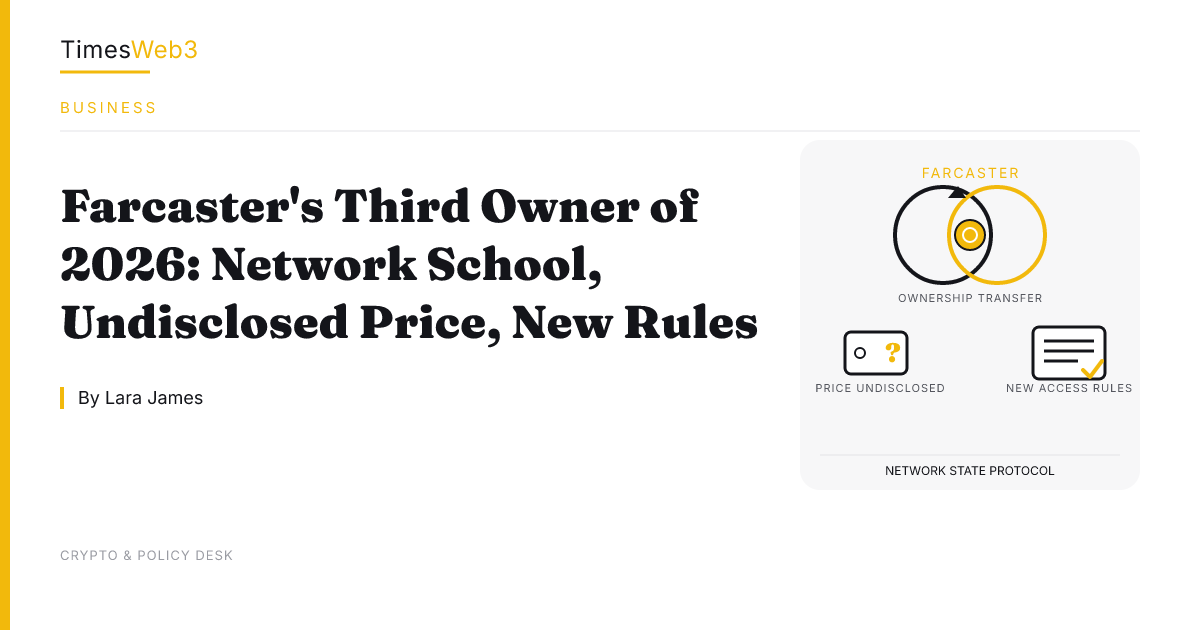
Farcaster just changed hands for the second time this year, and the terms of the deal tell a different story than the rebrand announcement does. Balaji Srinivasan’s Network School is taking over the app, its protocol repositories and related products from Neynar, according to The Block, but no purchase price has been disclosed by either party.
What’s changing isn’t just the logo. Farcaster is being renamed the “Network State Protocol,” and access to it is being tied to a signed agreement and an NFT, a structure that effectively turns a formerly open social app into a membership product. For a platform that has already been sold once this year, the economics of who controls it, and who gets to use it, are now the story.
Key Takeaways
- Network School, led by Balaji Srinivasan, is acquiring Farcaster’s app, protocol repositories and related products from Neynar, with no financial terms disclosed, according to The Block and Yahoo/Bankless.
- The platform is being renamed the “Network State Protocol.” Users must accept a new “social smart contract,” with an NFT confirming agreement; those who decline get read-only access and have their accounts and assets moved to another client.
- This is Farcaster’s third steward in 2026: the original team, then Neynar in January, now Network School, per Yahoo/Bankless.
- Neynar co-founders Rish and Manan are stepping away, though a portion of Neynar’s staff is moving over with the deal. Clanker, the token launchpad that came with Neynar’s January takeover, went unmentioned in the handoff.
- Balaji says the underlying protocol stays open to all builders, but the flagship app will enforce stricter, AI-assisted moderation, including retroactive review of past posts, according to 399btc.com.
A Third Owner, No Price Tag
Farcaster has now changed hands twice in under a year, moving from its original team to Neynar in January and now to Network School, according to Yahoo/Bankless. The deal, which 399btc.com reports closed on October 15, covers the main app, the protocol codebase and associated products, with a portion of Neynar’s staff transitioning to Network School. Neynar co-founders Rish and Manan are both stepping away from the project.
Neither outlet in the brief discloses financial terms. That matters for a platform built on open protocol principles: without a disclosed price, there’s no public signal of what the market thinks a decentralized social network with an existing user base, a token-launch sidecar, and a contested moderation model is actually worth. CoinMarketCap also covered the acquisition, consistent with the other two outlets on the basic fact of the sale.
Paying for Access: The Social Smart Contract
The business model shift is as significant as the ownership change. Under Network School, users are asked to accept an onchain “social smart contract” governing behavior on the platform, with an access NFT issued to confirm agreement, per The Block and Yahoo/Bankless. Users who decline are dropped to read-only access in the main app, and their accounts and assets are moved to a different client.
Enforcement is retroactive, not just forward-looking. 399btc.com reports the new rules apply to previously published posts as well as future ones, with moderation combining AI and human review across what the company describes as millions of pieces of content. The exact number of restricted accounts hasn’t been disclosed, and there’s no independent verification mechanism cited. Affected users reportedly include former engineers and early contributors, whose accounts have been temporarily locked. Network School also plans to introduce AI moderation more broadly and will gradually require users to verify they’re human, according to The Block.
A Contested Definition of “Open”
Balaji has framed the overhaul as building “the Singapore of social media,” pairing tougher moderation with an appeals process, according to Yahoo/Bankless. Per 399btc.com, he has also compared the approach to Salvadoran President Nayib Bukele’s crackdown on crime, arguing that removing repeat rule-breakers reduces systemic abuse and improves the platform overall. He says the underlying protocol remains open to all builders even as the flagship app becomes more opinionated, and he’s characterized the opt-out path, where dissenting users keep their private keys, funds, follower graphs and post history and can migrate to another client, as a form of “decentralized democracy.” Balaji has cited 92.9% voting support for the proposal, though that figure’s source hasn’t been independently verified, per 399btc.com.
Not everyone buys the framing. Former Eigen Labs India lead Kunal Gandhi publicly called the retroactive bans “absurd and contrary to the original intent” of the platform, arguing the idiosyncratic behavior now being penalized is part of what gave Farcaster its culture, according to 399btc.com.
What’s Left Out of the Deal
One detail got no mention in the handoff: Clanker, the token launchpad that arrived with Neynar’s January acquisition, according to Yahoo/Bankless. For a protocol whose commercial viability has leaned partly on token-launch activity, the silence leaves an open question about whether that revenue layer continues, gets spun out, or disappears under the new ownership.
What to Watch
Network School has said it will roll out an open-source-weighted AI model to help enforce the new rules and improve early warnings for users at risk of penalties, per 399btc.com. Also worth tracking: how the appeals process holds up in practice, how the developer community responds to a platform now run by its third steward in a year, and what happens to Clanker, left unaddressed in the acquisition announcement.