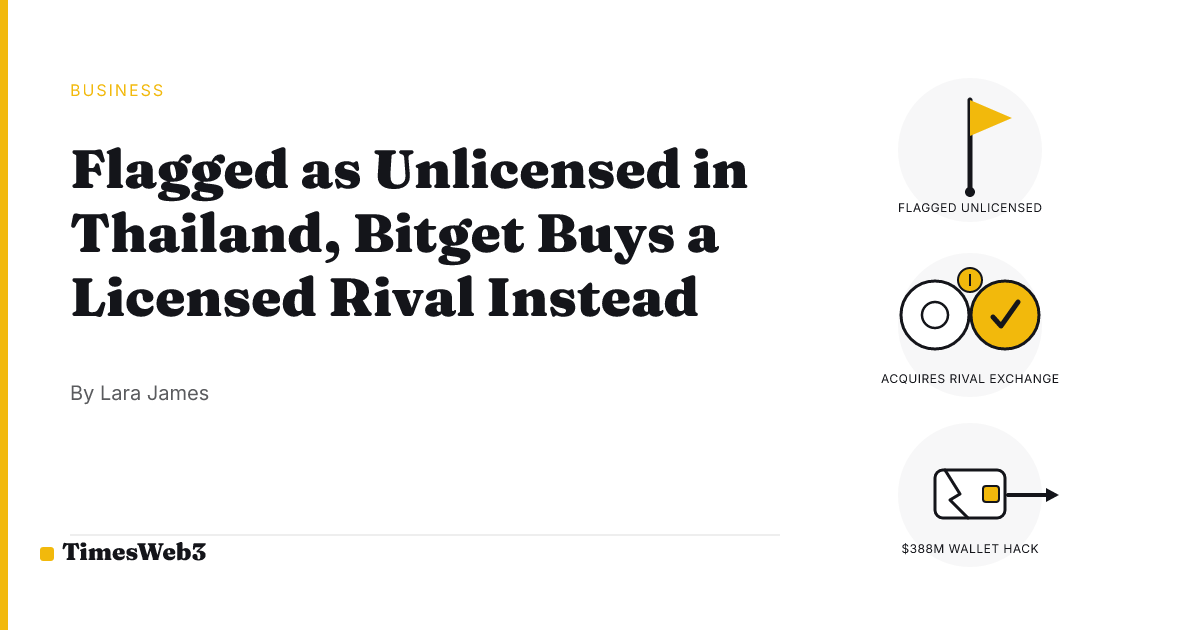
Bitget’s problem in Thailand isn’t capital. It’s a license.
Thailand’s Securities and Exchange Commission still listed Bitget on its investor warning system as an unlicensed digital asset business as of an Oct. 19 update, according to news.bitcoin.com. Rather than wait out that status or apply for its own license, Bitget has moved to buy one: a deal to acquire GMO-Z.com Cryptonomics (Thailand), the operator behind the licensed Z.com EX exchange, through BTGT Management (Thailand), a company in which Bitget says it holds an interest.
The timing matters. The proposal lands about four weeks after a Sept. 24 attack on Bitget’s hot and warm wallets that the exchange says affected roughly $388 million, and it comes as Bitget’s own updated terms of use list Thailand among prohibited jurisdictions, according to Cointelegraph.
Key Takeaways
- Bitget plans to acquire GMO-Z.com Cryptonomics (Thailand), operator of the licensed Z.com EX exchange, via BTGT Management (Thailand), in which Bitget holds an undisclosed interest.
- GMO Internet and its Thai subsidiary together hold 99.94% of the target (49% and 50.94%, respectively) and plan to sell their entire combined stake, per a Sept. 24 filing.
- The target posted an operating loss of 74.16 million baht in 2025, narrower than 101.68 million baht in 2024 and 115.33 million baht in 2023, while revenue fell to 11.02 million baht from about 13.2 million baht.
- The deal is targeted to close Oct. 31 but remains subject to regulatory approval of the change of control; Thailand’s SEC still lists Bitget itself as unlicensed as of Oct. 19.
- The acquisition follows a $388 million hack of Bitget’s hot and warm wallets on Sept. 24, with withdrawals fully restored by Oct. 2.
A licensed route around Bitget’s own ban
Thailand requires digital asset exchanges to carry a license from its SEC, and the regulator has not been shy about enforcing that against large offshore platforms. Authorities scheduled access blocks for five unlicensed exchanges, including Bybit, OKX, 1000X, Coinex and XT.COM, for June 28, 2025, and urged affected investors to withdraw their assets beforehand, according to news.bitcoin.com. Bitget’s own updated terms of use, revised Oct. 16, list Thailand as a prohibited jurisdiction alongside Russia, Belarus and Kazakhstan, per Cointelegraph.
Buying a company that already holds the license sidesteps that bottleneck. GMO-Z.com Cryptonomics operates Z.com EX, which launched in February 2021 with authorization from both the Thai SEC and the Ministry of Finance and initially listed bitcoin, ether, XRP, litecoin, bitcoin cash and stellar, according to news.bitcoin.com. Thailand’s SEC lists the company among its licensed digital asset exchange operators, per Cointelegraph. Completion still requires regulatory sign-off on the change of control, so the license doesn’t transfer automatically just because the shares do.
What Bitget is actually buying
The seller is exiting, not expanding. GMO Internet Inc. directly holds 49% of the Thai operator, with its subsidiary GMO-Z.com Holdings (Thailand) holding another 50.94%, a combined 99.94% stake that both entities plan to transfer to zero as part of the sale, according to a Sept. 24 disclosure cited by news.bitcoin.com. GMO Internet had decided to withdraw from Thailand’s digital asset business, per crypto.news.
The business itself has been losing money for three straight years, though the losses are shrinking. GMO-Z.com Cryptonomics reported an operating loss of 74.16 million baht in 2025, down from 101.68 million baht in 2024 and 115.33 million baht in 2023, per the seller’s financial disclosure reported by crypto.news. Revenue moved the other direction, falling to roughly 11.02 million baht last year from about 13.2 million baht in 2024. At the end of 2025 the company held total assets of 451.03 million baht against net assets of about 11.4 million baht.
Neither Bitget nor the deal announcement has disclosed what stake it holds in BTGT Management or the purchase price. Bitget CEO Gracy Chen framed the move in terms of operating foundation rather than financial scale: “Building a presence in a market requires local expertise, an understanding of the regulatory environment and a long-term commitment to the market,” she said, adding that “Thailand is an important part of Southeast Asia’s digital asset landscape, and this acquisition gives us a great opportunity to establish local operations in a thriving country.” Investing.com reports Bitget continues to evaluate further Southeast Asia expansion and currently serves more than 125 million users across crypto tokens, tokenized stocks, ETFs, commodities and foreign exchange.
The hack is still part of the backdrop
The deal was announced less than a month after attackers exploited a vulnerability in a third-party security product to issue fraudulent withdrawal commands against Bitget’s hot and warm wallets on Sept. 24, affecting an estimated $388 million, according to Cointelegraph. Bitget has said customer account balances were unaffected and that it completed a phased restoration of withdrawals on Oct. 2. On Oct. 17 the exchange also said it would discontinue services for certain users, calling it a “one-off exercise.”
Coverage of the acquisition varies in how far along outlets describe the deal as being. Investing.com reports Bitget “has agreed to acquire” the Thai operator, while Cointelegraph and crypto.news describe it as a proposed or planned transaction. All three agree the transfer still needs regulatory approval, and none report a disclosed price or stake size.
What to Watch
GMO Internet targeted Oct. 31 for the share transfer, but that date depends on regulators approving the change of control, something that has not yet happened according to crypto.news. Whether Thailand’s SEC clears the deal while Bitget itself remains on the regulator’s unlicensed warning list, last updated Oct. 19, is the open question the timeline doesn’t yet answer. Bitget has not announced a launch date for its platform in Thailand once the acquisition closes.
Sources
- Cointelegraph: Bitget plans Thai crypto exchange acquisition weeks after $388M hack
- Investing.com: Bitget to buy GMO’s Thai crypto exchange in Southeast Asia push
- crypto.news: Bitget eyes Thai crypto exchange takeover weeks after $388M hack
- news.bitcoin.com: Bitget Agrees to Buy Licensed Thai Exchange Weeks After $388M Hack