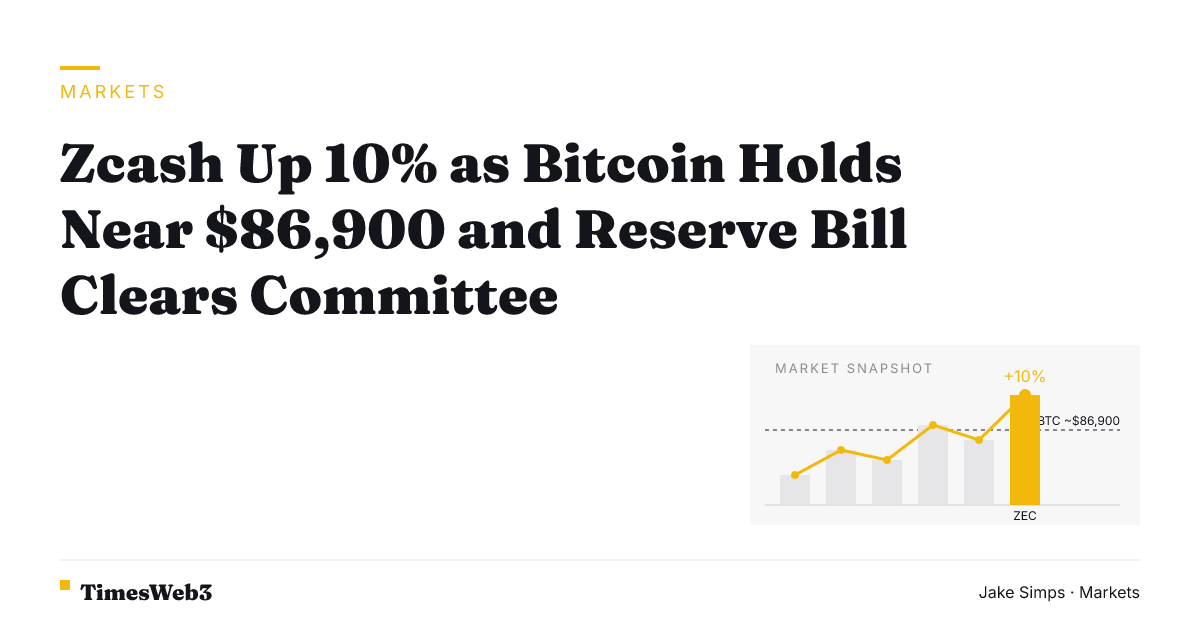
The bid in majors is not coming from bitcoin. Bitcoin held near $86,900, up 1% over 24 hours, while Zcash gained 10% and XRP gained 6%, according to CoinDesk on Sept. 23. The largest asset is the flattest one on the board.
Two items out of Washington sit behind the tone. The House Financial Services Committee approved the American Reserve Modernization Act on Sept. 17, and the Securities and Exchange Commission used an innovation exemption to open a path for onchain trading of tokenized U.S. stocks. Neither is priced into a single 24-hour candle, but both change what the structural bid for bitcoin could look like.
Key Takeaways
- Zcash rose 10% to just above $1,616, the largest gain among major tokens in the 24 hours to Sept. 23.
- Bitcoin held near $86,900, up 1% over the same period. Ether, BNB and SOL each gained under 1%.
- XRP added 6% to just above $1.62 and DOGE picked up 4%.
- The House Financial Services Committee approved the American Reserve Modernization Act on Sept. 17 by 28 votes to 21, sending it toward a full House vote.
- The bill would place roughly 325,000 bitcoin the government already holds into a Strategic Bitcoin Reserve at the Treasury, with a minimum 20-year hold and quarterly audited proof.
The Move Sat Outside Bitcoin
Zcash led, at 10% to just above $1,616. That was the largest gain among major tokens over the 24-hour window.
Below it, the moves thinned out fast. XRP added 6% to just above $1.62. DOGE added 4%. Bitcoin added 1% and sat near $86,900. Ether, BNB and SOL each came in under 1%.
The shape of that tape matters more than any single print. When the three largest smart-contract-adjacent majors move less than a percent and the leaders are a privacy token and XRP, the day’s flow is rotational rather than broad. Bitcoin is not leading the move. It is holding a level while capital works further down the list.
What the Reserve Bill Would Actually Lock Up
The American Reserve Modernization Act is not a purchase program. It is a custody and disclosure regime for coins the U.S. government already controls.
The bill would place the roughly 325,000 bitcoin already held by the government into a Strategic Bitcoin Reserve at the Treasury. It would require those coins be held for at least 20 years. It would also mandate quarterly audited proof that the bitcoin is still there.
That third clause is the one with market mechanics attached. A statutory 20-year hold removes a known potential supply overhang from circulation, and a quarterly audit turns the balance into a published, recurring number rather than a matter of chain-watching and inference. The committee cleared it 28 to 21 on Sept. 17. It now goes toward a full House vote.
The SEC Moved Where Congress Stalled
The reserve bill is not the only Washington track running. With the CLARITY Act stalled, the SEC stepped in using an innovation exemption to clear a path for onchain trading of tokenized U.S. stocks within a day.
The timing is the story. One market-structure vehicle is stuck in the legislature while the regulator delivers a narrower version of the same outcome through exemptive authority. For anyone modelling when tokenized equities reach venues, the route matters: a rulemaking exemption and a statute carry different durability and different reversal risk.
Read together, the two items describe a policy environment moving on two separate clocks. The reserve bill is at the committee-cleared stage with a floor vote ahead of it. The tokenized stock path is already open.
What to Watch
The next hard checkpoint is the full House vote on the American Reserve Modernization Act. The committee margin was 28 to 21, a split that does not automatically translate to a floor outcome, and the brief carries no scheduled date for that vote.
Two other things are worth tracking. First, whether the quarterly audited proof requirement survives to the final text, since that provision is what turns the 325,000 bitcoin figure into a verifiable, repeating disclosure. Second, whether the SEC’s innovation exemption route for tokenized U.S. stocks gets used again while the CLARITY Act remains stalled.
On the tape, the question is whether the rotation that put Zcash at 10% and bitcoin at 1% persists, or whether the majors that finished under 1%, ether, BNB and SOL, close that gap.