What the vote is actually about
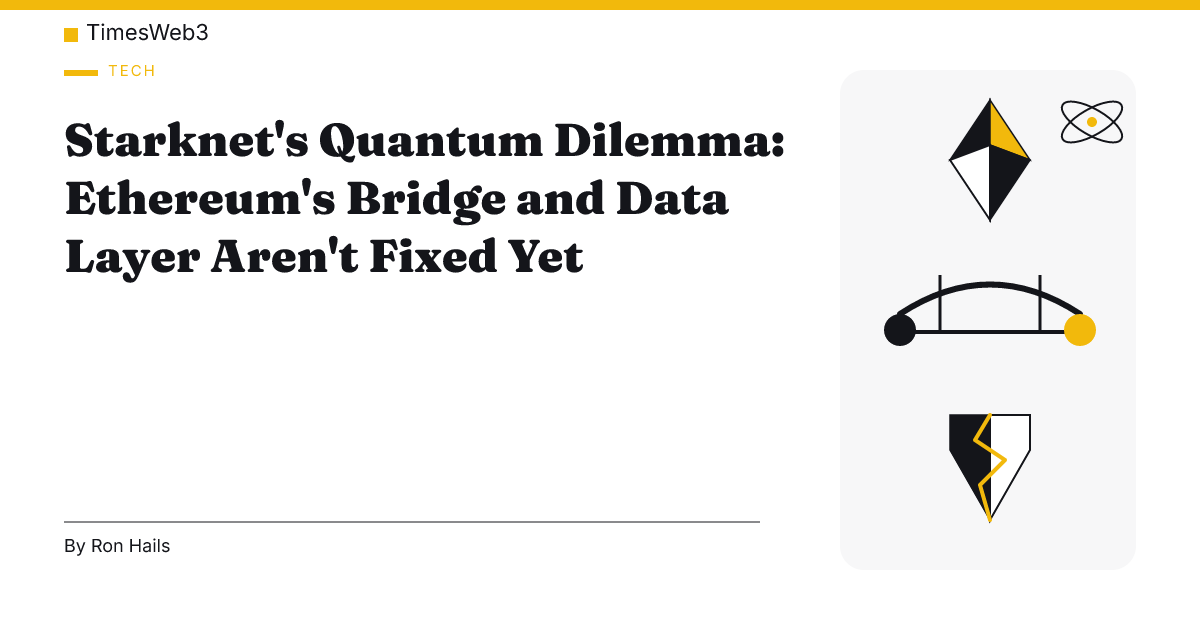
A rollup’s security model is only as strong as the layer it settles to, and that’s the technical problem Starknet is trying to solve by asking its token holders about leaving Ethereum. Starknet currently depends on Ethereum for core infrastructure, including its bridge and data availability, and StarkWare has identified both as remaining quantum-security dependencies that it cannot harden on its own timeline while they sit on Ethereum, according to Cointelegraph.
That’s a different kind of exposure than a smart-contract bug or a key-management flaw. It’s a statement that the settlement and data layers a rollup inherits from its base chain can become the limiting factor in how fast that rollup can harden itself against a future threat, and StarkWare argues it would rather control that timeline directly than wait on Ethereum’s.
Key Takeaways
- Starknet opened a non-binding, seven-day vote on Oct. 15 asking STRK holders whether the network should explore becoming an independent, post-quantum layer-1, with voting closing Oct. 22, according to Cointelegraph.
- A “Yes” vote only supports further research. It does not authorize a transition, which would require additional proposals and governance votes, and no timetable for becoming an L1 has been set.
- StarkWare says Starknet’s remaining quantum-security gaps sit in Ethereum-dependent infrastructure, specifically its bridge and data availability.
- StarkWare CEO Eli Ben-Sasson has framed the goal as making Starknet “the first fully quantum-resistant network” by 2027, versus Ethereum’s post-quantum protocol work, which targets initial protections by 2029.
- Coverage of the vote’s outcome is inconsistent: KuCoin reported a 99.95% result in favor of transitioning on Oct. 18, four days before Cointelegraph’s stated Oct. 22 close.
The mechanics: three choices, no commitment
The poll StarkWare put in front of STRK holders offers three options: support further research into independence, oppose it, or stay neutral pending more information, according to Cointelegraph. Voting opened Thursday, Oct. 15, and is scheduled to close Oct. 22, with results to be published afterward. A separate report citing the same Oct. 22 deadline appeared in coverage from aeeze.com.
Crucially, a “Yes” result doesn’t commit Starknet to anything beyond research. Any actual move to independent L1 status would need further proposals and separate governance votes, and StarkWare has not published a timetable for making that transition, according to Cointelegraph.
Why the bridge and data layer are the sticking points
Starknet’s proofs already use STARKs rather than SNARKs, and that distinction matters for the quantum conversation. STARK proofs rely solely on hashes and don’t require a trusted setup, which L2BEAT’s documentation on Starknet notes makes the proof system itself secure against quantum computers, according to WEEX. That’s in contrast to ZKsync Era, which wraps STARK proofs with SNARKs for efficiency, a method that depends on a trusted setup ritual.
So the proving layer isn’t StarkWare’s concern here. The exposure StarkWare is pointing to sits one layer up, in the bridge contracts and data availability mechanisms that Starknet still settles through Ethereum. Ben-Sasson told Cointelegraph that quantum-proofing crypto is urgent and that Starknet needs to “move at lightning speed,” contrasting that urgency with what he described as slower progress at Ethereum and Bitcoin, according to Cointelegraph. Earlier reporting cited by WEEX quotes Ben-Sasson saying in early October that StarkWare was “considering multiple options, including migration to L1” as a countermeasure against quantum computers, with no migration roadmap reported at that time.
Ben-Sasson and Starknet had already signaled the proposal in separate X posts on Oct. 8, framing the effort as a push to become “the first fully quantum-resistant network” by 2027, according to Cointelegraph. That target sits well ahead of Ethereum’s own post-quantum effort: Ethereum developers set up a dedicated post-quantum team in March, aiming for initial protocol-level protections by 2029. In June, StarkWare had already laid out a three-phase quantum-resistance roadmap of its own, covering signature upgrades, smart-contract migration, and the Ethereum-dependent infrastructure now at the center of this vote.
A disputed outcome before the vote has closed
Coverage of the vote’s status doesn’t line up cleanly. Cointelegraph describes the poll as open, running through Oct. 22, with results to follow. KuCoin, in coverage published Oct. 18, reported a 99.95% vote in favor of transitioning to an independent L1, four days before that stated close date. Neither the brief’s Cointelegraph reporting nor the aeeze.com coverage, both of which cite the Oct. 22 deadline, mention a result having already landed. That gap between a headline declaring a near-unanimous outcome and other outlets still describing the vote as in progress is worth tracking as results are formally published.
Separately, usage data underscores why StarkWare is defending the L2’s current standing even as it debates leaving Ethereum. Over the 30 days to mid-October, Starknet processed 7.31 times more transactions than ZKsync Era, and its collateral value of $593.4 million ran 1.96 times ZKsync Era’s $309 million, a gap that widens to 2.36 times once each chain’s native token is excluded from the total, according to WEEX.
What to Watch
The poll closes Oct. 22, with Starknet set to publish results afterward, according to Cointelegraph. Watch for whether that outcome confirms or contradicts the 99.95% figure already circulating from KuCoin, and for whatever follow-up governance proposals StarkWare brings forward if the research mandate passes. Any detail on how the three-phase roadmap, especially its signature-upgrade and Ethereum-dependent-infrastructure phases, intersects with an independent-L1 path would be the next concrete marker toward the 2027 target Ben-Sasson has described.