Solana is about to change what “final” means for a transaction
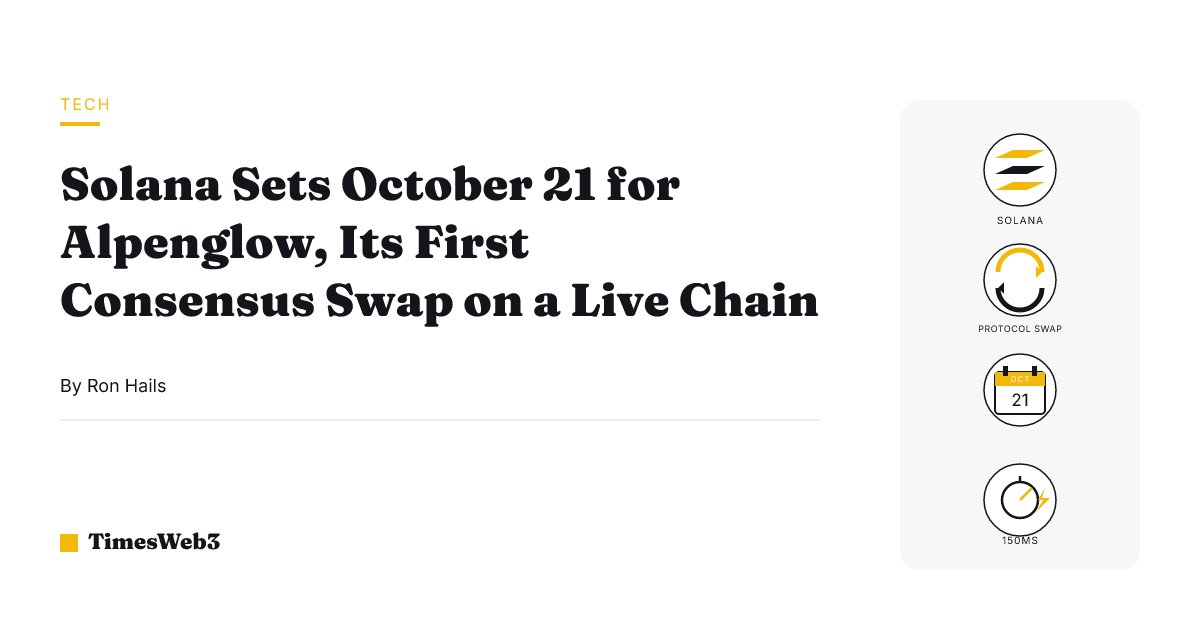
Solana has set Oct. 21 for Alpenglow, an upgrade that swaps out the consensus engine the network has run since it launched and aims to cut the time a transaction takes to become irreversible from seconds to roughly 150 milliseconds, according to CoinDesk. Core developer Anza, which builds Solana’s Agave validator client, called the migration “the world’s first swapping consensus engines on a live network,” according to Solana Compass.
The distinction matters beyond raw speed. A Solana payment can already look successful almost instantly, but Alpenglow is meant to give a stronger guarantee that it cannot be reversed, the kind of assurance a merchant or a cross-chain bridge needs before releasing funds on the other side, per CoinDesk.
Key Takeaways
- Solana’s Alpenglow upgrade is scheduled for Oct. 21, targeting transaction finality of about 150 milliseconds, replacing the TowerBFT consensus protocol used since genesis.
- Validator votes move off-chain as direct signed messages between nodes instead of on-chain transactions, which could sharply cut Solana’s reported transaction count without any real drop in user activity.
- Validators must run Agave 4.3.0, while Firedancer and Frankendancer operators need to switch software temporarily; voting fees of roughly 1 SOL per epoch are replaced by a flat 0.8 SOL admission fee.
- The migration targets epoch 1064, with CoinDesk citing roughly 15:00 UTC and Anza citing about 14:50 UTC for the start of the process on Oct. 21.
What Alpenglow actually changes
TowerBFT, the protocol Solana has used since its 2020 launch, requires validators to submit votes as on-chain transactions. Alpenglow replaces it with Votor, which lets validators exchange votes directly as signed messages between nodes and combine enough approvals into a certificate that finalizes a block, according to CoinDesk and The Defiant. Under the new design, a block finalizes in one round if 80% of stake responds, or after two rounds at 60%, Anza said, per CoinMarketCap.
Alpenglow also removes Proof of History, Solana’s built-in clock, and changes the network’s fault-tolerance math: it can withstand 20% of stake acting maliciously and another 20% going offline at the same time, versus TowerBFT’s threshold of under 33% malicious stake, CoinMarketCap reported.
Pulling votes off the ledger has a side effect CoinDesk flagged directly: Solana’s headline transaction count could fall sharply once votes stop appearing as on-chain transactions, even if trading and payment activity holds steady. That is an optics change in how the network’s usage gets measured, not a change in actual usage.
How the one-slot handoff is supposed to work
The migration follows a four-step sequence laid out in SIMD-0384, written by Anza’s Kobi Sliwinski, Ashwin Sekar and Carl Lin, per Solana Compass. A feature gate activates at an epoch boundary, and 5,000 slots later, blocks stop carrying user transactions and hold only validator votes, a step Anza says makes the handoff safe because “every block past the boundary can be rolled back without losing anything a user signed.”
Validators then wait for a block to collect votes from 82% of stake, which becomes the Alpenglow genesis block once that certificate forms. From there, validators roll back any blocks produced after that point, hand consensus to Votor, and resume processing user transactions, a step Anza expects “to take hundreds of milliseconds,” according to Solana Compass. CoinDesk’s account describes the same window somewhat differently, saying the old voting system runs for the first 5,000 slots before the network switches to Alpenglow about 18 minutes later.
Outlets differ on the exact start time. CoinDesk cites roughly 15:00 UTC for epoch 1064, while Anza’s own post says “Alpenglow goes live on mainnet-beta Wednesday, October 21, ~14:50 UTC,” calling it “18 months of work for a migration that happens in one slot,” per CoinMarketCap. Solana Compass noted Anza hasn’t clarified whether that time marks the feature gate activating or the handoff completing, and estimated, based on recent epoch lengths, that epoch 1064 would begin between roughly 14:55 and 15:10 UTC.
What validator operators need to do
Wallet users and most app developers have nothing to prepare, but validator operators face two hard requirements before Oct. 21, Solana Compass reported. They need software built on Agave 4.3.0, and operators running Firedancer or Frankendancer, alternative validator clients, will need to switch to Agave temporarily since those programs won’t support the initial migration, per CoinDesk.
The fee structure for voting also changes. Validators currently pay roughly 1 SOL per epoch to submit votes; that cost disappears under Alpenglow and is replaced by a flat 0.8 SOL admission fee, CoinDesk reported.
The groundwork has already been tested elsewhere on Solana’s infrastructure. The migration ran successfully on a community cluster, on testnet on Sept. 24, and on devnet on Sept. 25, and Anza’s site lists a bug bounty of more than 25,000 SOL alongside nine successful migrations simulated across 1,500 nodes, according to Solana Compass. Solana validators approved the Alpenglow proposal in a governance vote in September 2025, and it entered community validator testing in May, The Defiant and CoinMarketCap reported.
What to Watch
The migration targets epoch 1064 on Oct. 21, with validators watching for the feature gate activation, the 5,000-slot boundary, and the 82% genesis certificate that triggers the handoff to Votor. A second component of Alpenglow, called Rotor, is set to replace Turbine, the system Solana uses to spread blocks across the network, at a later stage, per CoinMarketCap.
Sources
- CoinDesk: Solana sets Oct. 21 for Alpenglow upgrade targeting 150-millisecond finality
- The Defiant: Anza Sets Oct. 21 for Solana’s Alpenglow Mainnet Upgrade
- CoinMarketCap: Solana’s Alpenglow Upgrade to Go Live on Mainnet Oct. 21, Anza Says
- Solana Compass: Anza Sets Alpenglow Mainnet Date: Solana’s Consensus Switch Is Scheduled for October 21 at About 14:50 UTC