A GDP print out of Beijing moved bitcoin more than a week of crypto-specific news did
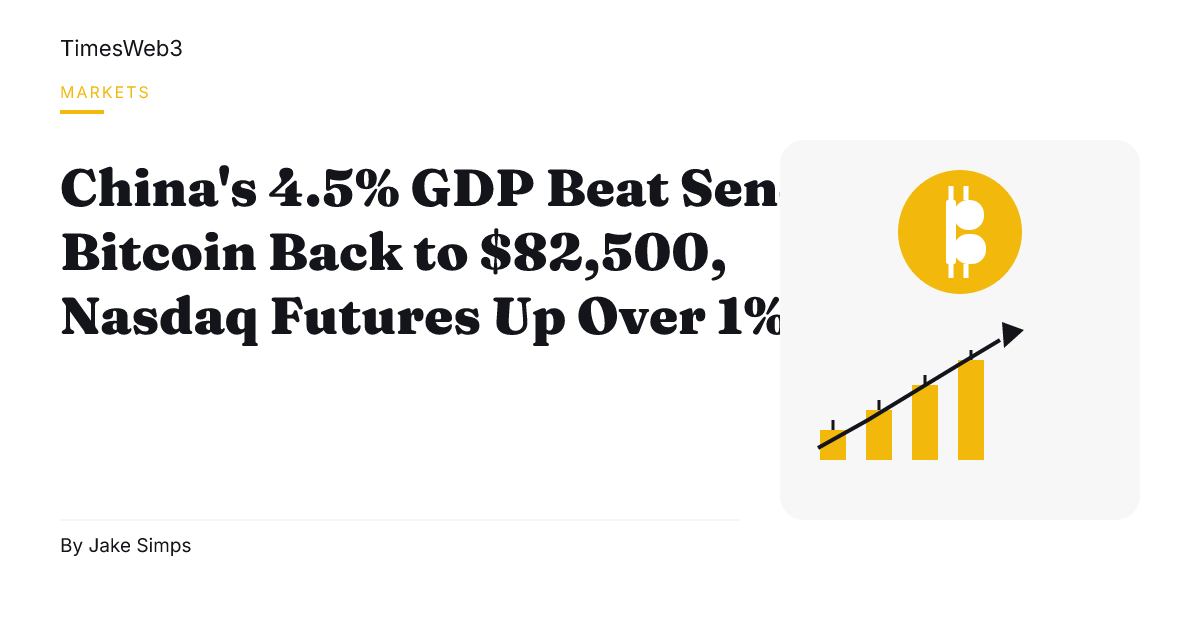
Bitcoin traded near $82,500 on Monday, up 1.3% over 24 hours, after China’s National Bureau of Statistics reported third-quarter GDP growth of 4.5% year on year, according to CoinDesk. That beat the second quarter’s 4.3% pace. The move put bitcoin back in positive territory after a week in which it fell roughly 3% alongside a tech-led stock selloff, according to Moneyweb.
Key Takeaways
- Bitcoin traded around $82,500 on Oct. 19, up 1.3% over the prior 24 hours, after climbing as much as 2.3% in early Asia trading to roughly $82,400 at noon in Singapore, according to CoinDesk and Moneyweb.
- China’s Q3 GDP grew 4.5% year on year versus 4.3% in Q2, and retail sales rose 1.1%, more than double the 0.5% forecast, according to CoinDesk.
- Nasdaq futures rose more than 1%, Japan’s Nikkei gained 1.8% and South Korea’s Kospi added 0.6%, reversing some of last week’s AI-stock losses.
- Oil fell on both sides of the Atlantic, with Brent down as much as 2%, though outlets differ on the driver: a Trump Russia waiver versus steady Middle East supply.
- US spot bitcoin ETFs logged $228.6 million in outflows last week, a second straight week of net selling after $681 million the week before, according to Moneyweb and Free Malaysia Today.
China’s growth numbers move the tape
The headline number is retail sales, not just GDP. China’s retail sales rose 1.1% in the period, more than double the 0.5% increase economists expected and up from 0.4% the prior month, per CoinDesk’s reporting. That combination, faster GDP growth plus a retail sales beat, reads as stronger domestic demand in the world’s second-largest economy and a major importer of industrial commodities. CoinDesk frames the reaction as mechanical: strong China data tends to encourage risk-taking across financial markets broadly, not just in equities.
The equity reaction was broad-based. Nasdaq futures rose more than 1%, Japan’s Nikkei gained 1.8% and South Korea’s Kospi rose 0.6%, per CoinDesk. Moneyweb put the futures move at 1.3% for Nasdaq 100 contracts specifically, with S&P 500 futures up roughly 0.8%. Chinese stocks rose 0.3%. Those indexes had taken losses last week led by AI-related shares, and Monday’s session reversed part of that.
Bitcoin’s move sits inside last week’s range
Bitcoin’s gain Monday didn’t break new ground. CoinDesk had it near $82,500, up 0.7% since midnight UTC and 1.3% over 24 hours. Moneyweb and Free Malaysia Today reported a larger intraday pop, as much as 2.3% in early Asia trading, with the price hovering around $82,400 at noon in Singapore. Both outlets note bitcoin remains within last week’s $80,000 to $85,000 trading range.
Other tokens moved more. Ether rose as much as 3.7% and Solana gained more than 4.6%, according to Moneyweb and Free Malaysia Today. Gold was little changed near $4,180 an ounce, and the Dollar Index held below 102, extending last week’s weakness, per CoinDesk and Bloomingbit.
Not every voice called it a durable turn. “No news is good news,” said Damien Loh, chief investment officer at Ericsenz Capital, who described Monday’s move as a “retracement after a big risk-off week.” Loh told Moneyweb he sees no near-term catalyst for bitcoin to set new highs and views the risk as skewed to the downside given the broader risk environment.
Oil fell, but outlets disagree on why
Every outlet agrees oil dropped. CoinDesk and Bloomingbit say oil prices fell on both sides of the Atlantic, reversing some of last week’s gains, and attribute the move to Reuters reporting that expectations of a Trump administration Russia waiver would boost supply. Moneyweb and Free Malaysia Today instead attribute the drop to signs that Middle East supply has held up since the US war with Iran broke out, putting the Brent decline at as much as 2%. Moneyweb adds that oil remains elevated near $107 a barrel, higher than most of last week’s levels, despite the pullback. The two framings aren’t necessarily contradictory, since both cite supply-side relief, but they point to different events as the trigger, and neither CoinDesk nor Moneyweb cites the other’s explanation.
All sources flag that geopolitical risk in the Middle East hasn’t gone away even as oil retreats.
ETF outflows haven’t reversed
Institutional buying, at least through ETFs, is still running the other way. US-listed spot bitcoin ETFs recorded $228.6 million in net outflows last week, following $681 million in outflows the week before, according to Moneyweb and Free Malaysia Today. Neither CoinDesk nor Bloomingbit mentions ETF flows, so that detail comes from the Bloomberg-sourced reporting carried by those two outlets.
What to Watch
CoinDesk notes the Federal Reserve is expected to hold its benchmark rate in the 4.75% to 5% range at its meeting this month, after a 25 basis point hike last month. A sustained decline in oil, per CoinDesk, could ease inflation pressure and open room for the Fed to cut later. Whether China’s demand strength holds up in subsequent data, and whether ETF flows turn positive again after two straight weeks of outflows, are the two threads outlets are tracking into bitcoin’s next move within its $80,000 to $85,000 range.
Sources
- CoinDesk: Bitcoin jumps to $82,500, stocks rise as China GDP beats estimates
- Bloomingbit: Bitcoin Reclaims $82,500 as Stronger China Data, Lower Oil Boost Risk Appetite
- Moneyweb: Bitcoin rebounds above $82 000 as oil’s retreat lifts risk mood
- Free Malaysia Today: Bitcoin rebounds above US$82,000 as oil’s retreat lifts risk mood