The question that has held back regulated finance from putting stablecoins, funds and bonds fully onchain is not whether a blockchain can move value. It is whether the network itself can enforce who is allowed to hold that value, and take it back when a regulator says so. The Cardano Foundation’s answer, live on mainnet as of Wednesday, is CIP-0113: a token standard where the ledger, not a company server, checks the rules on every transfer.
The Swiss nonprofit that supports Cardano’s development said the standard followed independent security audits and required no hard fork, according to CoinDesk. The launch was announced at the TOKEN2049 conference, according to Crypto Briefing and FinancialContent.
Key Takeaways
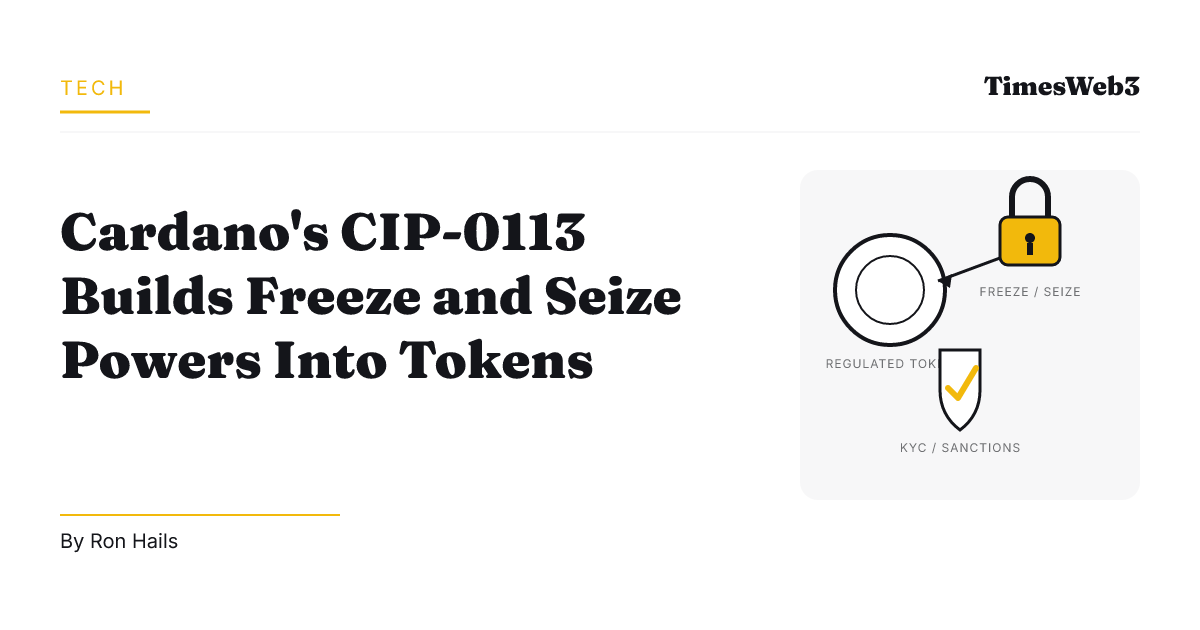
- CIP-0113 lets issuers of regulated tokens, such as stablecoins, funds and bonds, enforce KYC and sanctions checks, freezes, seizures and transfer restrictions directly on the Cardano ledger.
- The rules are checked by the network itself on every mint, burn and transfer, built on Cardano’s existing eUTXO model, and the upgrade required no hard fork.
- Wallets Eternl and GeroWallet, explorer CardanoScan and developer toolkit BloxBean already support the standard, and the Swiss Capital Markets and Technology Association recognizes CIP-0113 tokens as comparable to its CMTAT framework for tokenized securities.
- Holders accept real trade-offs: an authorized party can move tokens without the holder’s consent under the issuer’s rules, and the specification tells lending services to examine those powers before accepting a token as collateral.
How the Rules Travel With the Token
CIP-0113 attaches compliance logic to the token itself rather than to a wrapper or an off-chain system. Cardano Foundation CEO Frederik Gregaard put it directly: “The rules have to travel with the asset and be enforced every time it moves,” he said in a statement reported by CoinDesk and expanded in FinancialContent’s longer version of the quote, where he added that compliance is “enforced by the network itself rather than by a wrapper or a closed system.”
The mechanics sit on Cardano’s extended UTXO (eUTXO) model. Tokens live inside a shared smart contract, and the network checks the issuer’s chosen rules before accepting any transfer, mint or burn, according to CoinDesk and TokenPost. The design is modular: a core standard pairs with pluggable substandards that issuers can select or write themselves, and update later as regulation changes, without altering the base protocol, Crypto Briefing reported. Giovanni Gargiulo, a senior blockchain architect at the foundation, said the approach “keeps costs predictable and lets issuers add new rules as regulations change, without touching the core protocol,” per FinancialContent.
What Issuers Gain, and What Holders Give Up
The use case is narrow and deliberate. A fund restricted to verified investors could use the standard to reject a transfer to an unverified wallet, and a stablecoin issuer could block tokens from reaching a sanctioned address, CoinDesk reported. Those checks apply wherever the tokens move, including across different wallets and services.
The flip side is that holders are trusting the issuer as much as the code. CoinDesk’s reporting and Crypto Briefing’s both note that, depending on the rules an issuer sets, an authorized party can move tokens without the holder’s consent, a power that extends beyond simply blocking a bad transfer. The technical specification instructs lending services to examine those powers before accepting a CIP-0113 token as collateral. Importantly, the standard applies only to tokens whose issuers opt in; ADA itself is not being turned into a freezable asset, Crypto Briefing noted.
Support, Recognition and Where Cardano Stands Among Peers
Tooling is already live. Eternl, GeroWallet, CardanoScan and BloxBean support CIP-0113 at launch, a lineup confirmed across CoinDesk, Crypto Briefing and FinancialContent. The Swiss Capital Markets and Technology Association separately recognized CIP-0113 compliant tokens as comparable to its CMTAT framework, which is used to certify tokenized equity securities in Switzerland.
Cardano is not the first chain to attempt this. Ethereum has permissioned standards such as ERC-3643, Solana added transfer controls through token extensions, and the XRP Ledger already supports tokens whose issuers can restrict holders and claw back balances, CoinDesk reported. Phil di Sarro, CEO of Anastasia Labs and a community expert on the project, said the goal from the outset was tokens with “customized logic tailored to the needs of applications while retaining interoperability with Cardano’s existing ecosystem,” per FinancialContent.
The eUTXO Wrinkle
Cardano’s eUTXO model groups assets together the way cash sits in an envelope, with a single output potentially holding several tokens plus ADA at once, Crypto Briefing explained. If an issuer restricts one asset sitting inside a shared output, other tokens or ADA bundled in that same output could get caught up in the restriction. CIP-0113 addresses this through a mechanism the standard calls “unfracking,” but Crypto Briefing cautioned that wallets and DeFi protocols will still need to handle restricted and unrestricted assets carefully when bundling tokens together.
What to Watch
The proposal moved fast once it cleared review: community development and audits began in 2023, the CIP was formally merged into the official repository on September 29, 2026, and the foundation announced mainnet live roughly a week later at TOKEN2049, per Crypto Briefing. The near-term test is adoption: whether wallets and DeFi protocols implement the unfracking mechanism cleanly when handling mixed outputs, and whether lending platforms build in the vetting step the specification requires before taking CIP-0113 tokens as collateral.
Sources
- CoinDesk: Cardano gives token issuers power to freeze, seize and restrict assets
- Crypto Briefing: Cardano Foundation launches CIP-0113 token standard for compliance controls
- FinancialContent: Cardano Foundation Launches Programmable Token Standard, Bringing Ledger-Enforced Compliance to Tokenized Assets
- TokenPost: CIP-0113 Programmable Token Standard Goes Live on Cardano Mainnet