USDC becomes the first significant e-money token under MiCA
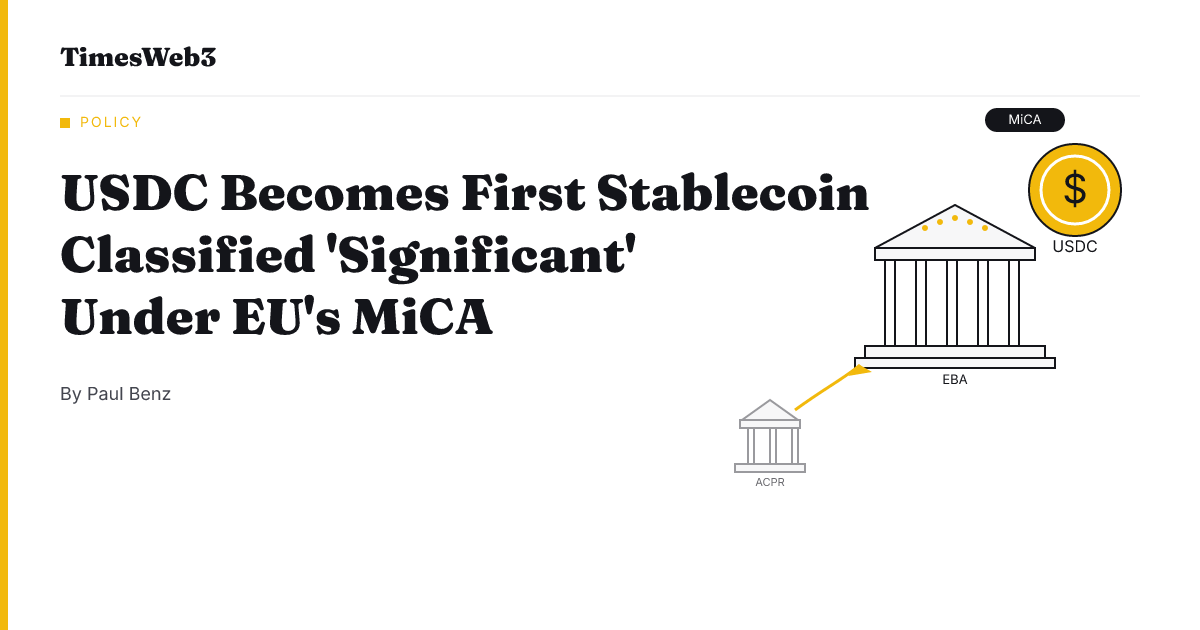
The European Banking Authority has moved USDC into the regulatory tier MiCA reserves for stablecoins it judges too large to leave under single-country oversight alone. Starting November 12, 2026, direct supervision of the token’s capital, reserve assets, liquidity requirements and recovery and redemption plans shifts from France’s banking regulator to the EBA itself, the first time any of the EU’s 45 notified e-money tokens has been pulled into that category.
The designation covers USDC as issued by Circle Internet Financial Europe SAS, Circle’s EU entity. It does not change how the token works or how it’s redeemed day to day. It changes who signs off on whether Circle’s reserves, capital and liquidity meet the bar, and that authority is now Brussels rather than Paris alone.
Key Takeaways
- The EBA designated USDC the first “significant” e-money token under MiCA, out of 45 EMTs currently notified in the EU.
- From November 12, 2026, oversight of USDC’s own funds, reserves, liquidity and recovery/redemption plans transfers from France’s ACPR to the EBA; the ACPR retains supervision of governance, qualifying holdings, outsourcing and conflicts of interest.
- The EBA has signed a memorandum of understanding with New York’s Department of Financial Services (NYDFS) to coordinate oversight of USDC across its EU and US issuing entities.
- According to Cointelegraph, USDC’s market capitalization sits at roughly $73 billion, versus about $184 billion for Tether’s USDt.
- Per FinanceXMagazine, the EBA reassesses significance annually, so the designation is not permanent and the list could grow.
What dual supervision actually splits
MiCA’s framework for significant EMTs divides responsibility rather than handing the whole file to one regulator. According to Finextra, the EBA takes direct responsibility for own funds, the reserve of assets, liquidity requirements and recovery and redemption plans, while the Autorité de Contrôle Prudentiel et de Résolution (ACPR) keeps supervision of governance, qualifying holdings, fit-and-proper assessments, outsourcing and conflicts of interest. Both authorities have said they’ll run a joint transition through the handover date.
That split matters for what it signals about the EU’s approach to large stablecoins: prudential soundness, meaning whether the reserves actually back the token, now sits with the bloc-wide supervisor, while day-to-day corporate conduct stays local. The EBA is required to make this call under MiCA Articles 43 and 56 once a token meets at least three of seven criteria set out in Commission Delegated Regulation (EU) 2024/1506, covering factors such as holder base size, tokens in issue, transaction volume, reserve size, international reach, links to the financial system and whether the issuer also provides other crypto-asset services, per FinanceXMagazine. The EBA’s own notice did not specify which criteria USDC tripped.
How USDC ended up alone in this category
Circle built its EU footprint ahead of the rest of the market. FinanceXMagazine reports Circle became the first global stablecoin issuer to reach MiCA compliance on July 1, 2024, after the ACPR granted it an electronic money institution licence it had applied for in March 2023. Tether’s USDt never obtained that licence, and major venues including Uphold, Binance, Kraken and OKX removed non-compliant tokens from their European platforms through 2024 and 2025, leaving USDC as the default regulated dollar stablecoin on EU exchanges, according to the same outlet. That incumbency is part of why it’s now the one carrying MiCA’s heaviest supervisory load: EURC, Circle’s euro-denominated token issued under the same French licence, was not caught by this decision.
The classification lands as EU-based issuers push regulators to accommodate dollar-pegged tokens alongside euro alternatives. “For European corporates to make cross-border payments globally, offering only a euro stablecoin isn’t enough,” AllUnity CEO Alexander Höptner told Cointelegraph.
The cross-border piece
Because USDC is issued separately in the EU by Circle Internet Financial Europe SAS and in the US by Circle Internet Financial, LLC, its reserves and redemption obligations span two jurisdictions. To manage that, the EBA has signed a memorandum of understanding with the NYDFS, which oversees Circle’s US operations, to facilitate cooperation and information exchange between the two regulators, according to Finextra.
What to Watch
The handover to EBA supervision takes effect November 12, 2026, when the agency formally assumes responsibility for USDC’s own funds, reserves, liquidity and recovery and redemption planning. Beyond that date, the designation itself isn’t fixed: the EBA reassesses significance annually against the same seven-factor test, meaning other EMTs could be added to the “significant” category, or the basis for USDC’s own status could shift, in future reviews.
Sources
- Cointelegraph: EU Banking Authority Labels Circle’s USDC as ‘First Significant E-Money Token’
- Finextra: EBA classifies USDC as significant e-money token under MiCA
- FinanceXMagazine: USDC Named EU’s First Significant E-Money Token
- PANews: Key News from Last Night and This Morning (October 14–October 15)