What changed
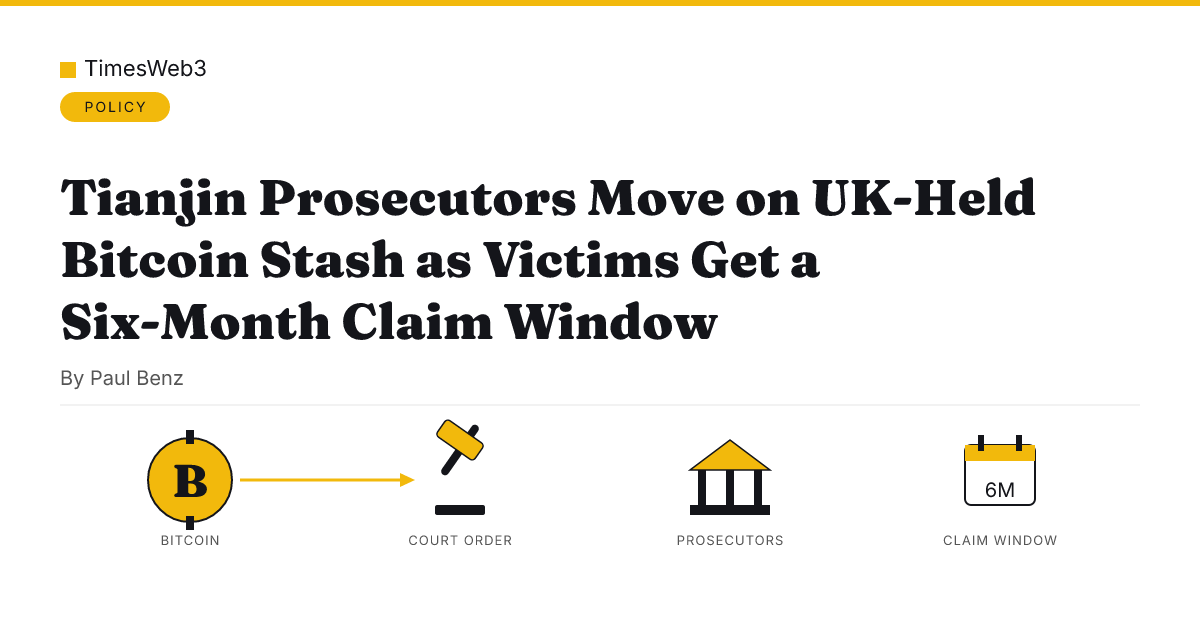
A Tianjin court has formally opened the door to stripping Qian Zhimin of more than 61,800 Bitcoin held in the United Kingdom, starting a six-month clock during which victims of her alleged $5.7 billion fraud can stake a claim to the recovered assets. The filing matters less for the size of the coin stash, though it is one of the largest ever tied to a single case, and more for the legal mechanics now in motion: a Chinese criminal confiscation proceeding running in parallel with a separate UK civil fight over who, under which country’s law, actually owns the Bitcoin.
Key Takeaways
- Tianjin’s Second Intermediate People’s Court accepted prosecutors’ application to confiscate more than 61,800 BTC (reported as 61,896 BTC by Decrypt and Grafa) plus other assets, after accepting the case on September 28 and publishing notice on October 13.
- The assets stem from an alleged scheme that raised more than 40.37 billion yuan (about $5.7 billion) from over 102,000 investors between 2014 and 2017, leaving losses of nearly 20 billion yuan, according to prosecutors.
- The court has opened a six-month window for victims and other interested parties to join the confiscation case; those who don’t participate can still seek refunds from recovered assets later.
- The move follows an October 12 UK High Court ruling that Chinese law, not English law, should govern victims’ claims to the Bitcoin seized in Britain.
- Qian Zhimin was sentenced in the UK to 11 years and 8 months in November 2025 after pleading guilty to acquiring and possessing criminal property, according to Decrypt.
The underlying fraud and how the coins were seized
Prosecutors allege Qian Zhimin controlled Tianjin Lantian Gree Electronic Technology (named Tianjin Lantian Gerui Electronic Technology in Decrypt’s and Grafa’s reporting), which sold unlicensed wealth-management products across China from 2014 to 2017, promising guaranteed principal and high returns. The scheme raised more than 40.378 billion yuan from more than 102,000 investors, who were left with losses of nearly 20 billion yuan, according to CoinDesk.
Rather than funding real business, prosecutors say the money was used to repay earlier investors, run fake investment projects, and buy Bitcoin, property, cars and jewelry. Qian fled China in July 2017 with computers holding Bitcoin wallets and eventually settled in the UK, where she converted some of the coins into other assets, according to Decrypt. British authorities later seized her holdings, including the Bitcoin along with bitcoin cash, bitcoin gold, bitcoin SV, XRP and Dogecoin, plus cash, jewelry and investment holdings.
Decrypt and Grafa both put the Bitcoin figure at 61,896 BTC, alongside roughly 72,746 units each of Bitcoin Cash, Bitcoin Gold and Bitcoin SV, about 3.6 million XRP and roughly 70 million Dogecoin, which UK authorities have already converted and placed in an interest-bearing account. CoinDesk and TokenPost round the figure to more than 61,800 BTC. Decrypt separately valued the Bitcoin at about $5.1 billion at a price of roughly $82,000, distinct from the $5.7 billion fraud total.
What the confiscation filing actually does
The Tianjin No. 2 Intermediate People’s Court accepted prosecutors’ application on September 28 and published a public notice on October 13, according to Decrypt and Grafa. Because Qian has been a wanted fugitive for more than a year, the case proceeds under Chinese rules that permit confiscation without the suspect present, Decrypt reported.
TokenPost frames the filing carefully: it is a request, not a completed transfer, and the Bitcoin figure describes the coin count sought while the $5.7 billion figure describes the alleged fraud’s size, not a valuation of the Bitcoin itself. Victims and other interested parties can apply to join the proceedings, reportedly through a WeChat mini-program per Decrypt, during the six-month notice period. Those who skip that step aren’t shut out entirely: CoinDesk and Grafa both note that non-participating victims can still seek refunds from whatever assets are eventually recovered.
A parallel fight in London
The Tianjin filing lands days after a UK High Court ruling with direct bearing on the outcome. On October 12, the court ruled that Chinese law, rather than English law, should govern victims’ claims to the more than 61,000 BTC seized in Britain, a decision CoinDesk describes as improving the UK government’s chances of retaining the coins. That ruling doesn’t resolve ownership outright. Instead, it sets up further hearings to assess whether victims hold a property claim under Chinese law, and lawyers for some victims are seeking to appeal, according to CoinDesk.
Decrypt adds context on how the UK case got here: Qian was sentenced to 11 years and 8 months in November 2025 after pleading guilty to acquiring and possessing criminal property. Unnamed Treasury officials had privately discussed whether the seized Bitcoin could help a UK public finances shortfall, the Financial Times reported at the time per Decrypt, while legal experts argued victims could be entitled to compensation if they could show a sufficient link to the coins. UK prosecutors have since said victims could be compensated through a redress scheme run from China. Law firm Fieldfisher, which represents claimants, said it is pursuing further action, though Decrypt’s reporting on that point was cut off in the material reviewed.
What to Watch
The six-month window for victims to join the Tianjin confiscation case runs from the October 13 notice, setting up a court hearing after that period closes. In parallel, the UK appeal effort flagged by CoinDesk and the further English hearings on victims’ property claims under Chinese law will shape whether, and how, any recovered value ultimately reaches the more than 102,000 people who lost money in the original scheme.