Turkey moves on a years-old Interpol notice, but the next legal step is still unconfirmed
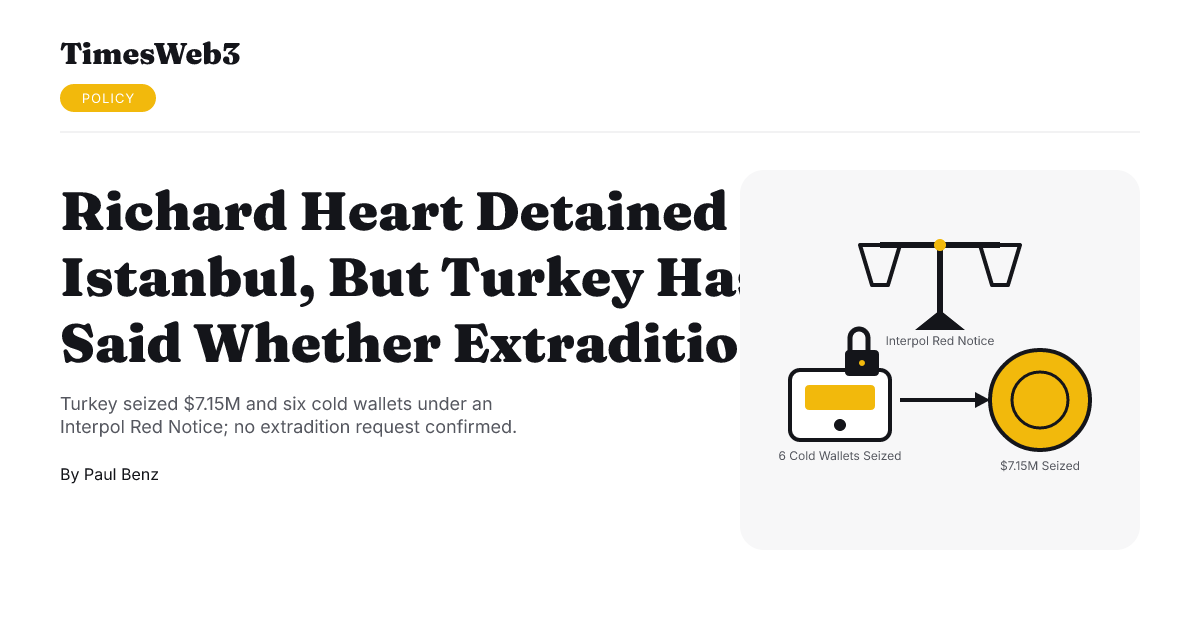
Turkey has turned a long-standing international manhunt into a concrete detention, but officials have stopped short of saying what happens to Richard Heart next. Turkish Justice Minister Akın Gürlek confirmed on Saturday that the Hex and PulseChain founder, legally named Richard James Schueler, was detained in Istanbul, closing the gap between an Interpol Red Notice issued nearly two years ago and an actual arrest on Turkish soil. What remains open is whether Ankara has received, or will act on, a request to extradite him.
Key Takeaways
- Turkish Justice Minister Akın Gürlek confirmed Richard Heart (Richard James Schueler) and his wife were detained in Istanbul’s Beşiktaş district on Oct. 14, with three alleged bodyguards detained afterward.
- Searches of 15 addresses in Beşiktaş, Üsküdar and Sarıyer yielded $7.15 million in cash, six cold wallets, firearms, ammunition and large quantities of luxury goods and electronics.
- Gürlek tied the detention to a Red Notice issued in December 2024 on Finland’s request and to allegations of $1 billion in crypto fraud in the U.S. and Finland, but did not say whether an extradition request exists.
- A U.S. federal judge dismissed the SEC’s civil suit against Heart in February 2025 on jurisdictional grounds, and the agency chose not to refile it.
What Turkish authorities confirmed
Gürlek’s statement, posted Saturday on the Turkish platform NSosyal, is the first official confirmation of an operation that Turkish media had already been reporting for three days, according to CryptoWatchDesk. He said the Istanbul Chief Public Prosecutor’s Office coordinated the operation, with the city police’s intelligence and financial crimes units carrying it out and Turkey’s National Intelligence Organization, MİT, providing support, according to Anadolu Agency.
Heart and his wife were detained on Oct. 14 in Istanbul’s Beşiktaş district. Three additional people, identified as the couple’s bodyguards, were detained in the days that followed, Gürlek said, according to The Block. Judicial proceedings against the suspects, and examination of the seized material, are ongoing, the minister added.
A large seizure, and a discrepancy with earlier reports
Police searched 15 addresses across Beşiktaş, Üsküdar and Sarıyer. The official haul, as Gürlek detailed it, includes $7.15 million and 160,000 Turkish lira (about $3,231) in cash, six cold wallets, 29 mobile phones, 12 laptops, 19 SSDs or external drives, 46 USB drives and 19 graphics cards, according to Turkey’s Ministry of Justice, basin.adalet.gov.tr. Also seized: 300 bags, 100 pairs of shoes, 136 pairs of glasses, 28 watches, 97 pieces of jewelry, four long-barreled rifles, three unlicensed pistols and 1,400 rounds of ammunition.
Those figures sit below what Turkish media reported earlier in the week, when outlets put the cash seized at $4 million and the number of luxury watches at 64, according to The Block. Anadolu separately reported that police impounded nine vehicles registered to Heart’s wife. Gürlek’s statement does not say what holdings, if any, sit inside the six cold wallets.
The legal trail behind the Red Notice
Gürlek linked the detention to an Interpol Red Notice issued in December 2024 at Finland’s request, and to broader allegations that Heart carried out $1 billion in crypto-asset fraud in the U.S. and Finland. Those Finnish suspicions were specifically tax offenses and assault, not investor fraud, according to CryptoWatchDesk, which cited Europol’s addition of Heart to its “Europe’s Most Wanted” list the same month.
The U.S. side of the case has already run into a jurisdictional wall. A federal judge in Brooklyn dismissed the SEC’s lawsuit against Heart in February 2025, citing a lack of ties between the alleged conduct and the United States, and the agency declined to refile the case that April, The Block reported. The SEC had accused Heart of raising more than $1 billion through unregistered securities offerings. Gürlek did not say whether Turkey has received an extradition request tied to either the Finnish or U.S. allegations, and no Turkish court decision on that question has been made public.
Gürlek framed the detention as a statement of policy rather than a one-off case. “We will not allow anyone to see Türkiye as a safe haven where they can escape justice,” he said, according to Anadolu. The Block reported it has reached out to the Helsinki Police Department and to David Kirk, Heart’s attorney in the SEC case, for comment; neither had responded publicly as of the reports reviewed here. Heart has not commented, and his X account last posted on Oct. 13, the day before the operation, according to CryptoWatchDesk.
The detention registered in token prices tied to Heart’s projects. Hex fell about 14% in the 24 hours after the news, according to CoinGecko data cited by The Block, while PulseChain’s PLS token was down 18.6% over the same window, trading at $0.00000574 as of 09:49 UTC Saturday, according to CoinGecko data cited by CryptoWatchDesk.
What to Watch
The open question is procedural: whether Turkey has, or will, receive a formal extradition request from the U.S. or Finland, and which jurisdiction’s case would take precedence given that the SEC’s civil suit was already dismissed on jurisdictional grounds. Gürlek said examination of the seized digital materials and cold wallets is continuing, which could shape what charges, if any, follow in Turkey itself. Responses from the Helsinki Police Department and from Heart’s attorney, both sought by The Block, would also clarify how the Finnish and U.S. threads of the case now intersect with Turkish custody.
Sources
- The Block: Turkey confirms Hex founder Richard Heart’s arrest, says police seized $7.15 million and six cold wallets
- Turkey Ministry of Justice: 1 milyar dolarlık kripto vurgununun şüphelisi İstanbul’da yakalandı
- Anadolu Agency: US national wanted over alleged $1B crypto fraud detained in Istanbul
- CryptoWatchDesk: Turkey confirms HEX founder Richard Heart’s detention, $7.15M seized