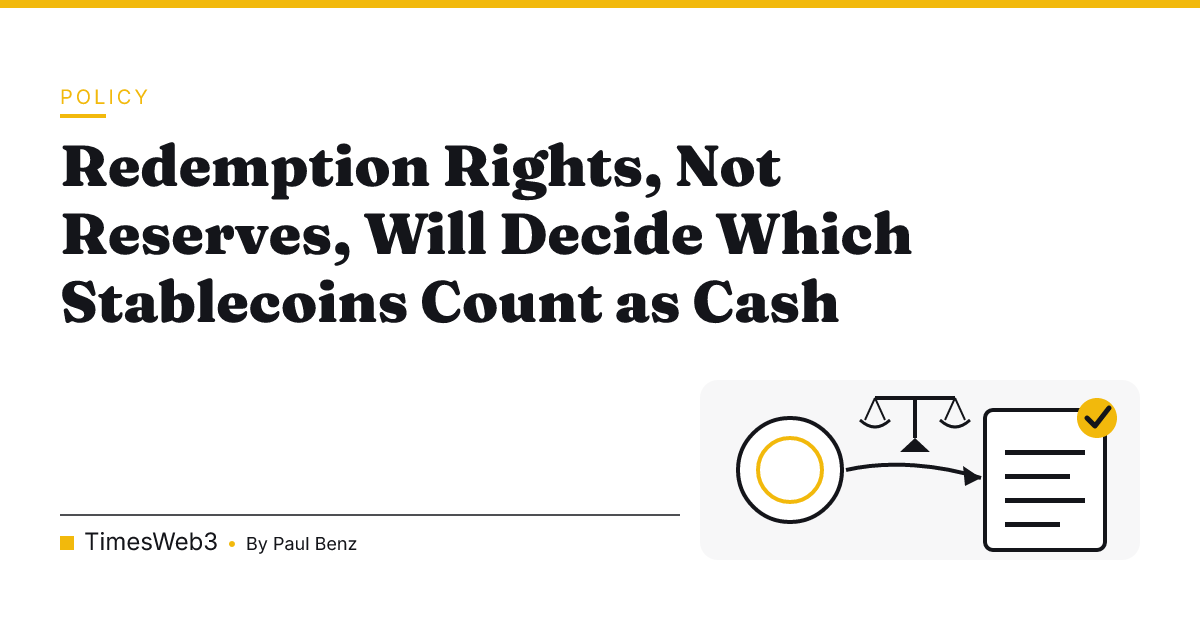
A proposed accounting rule could determine whether billions of dollars in corporate stablecoin holdings show up on balance sheets as cash, or as something murkier that trips liquidity ratios and loan covenants. The distinction turns on a contractual detail, not the token itself: whether the holder has a direct redemption right with the issuer.
That is the core finding of a report from Stripe-backed blockchain Tempo, which examined an Accounting Standards Update the Financial Accounting Standards Board (FASB) proposed in August, according to Cointelegraph. Under current practice, stablecoin holdings may not count toward a company’s reported cash reserves even when the tokens are fully backed by dollars, the outlet reported. The proposal would let qualifying holdings be classified as cash equivalents, removing an accounting barrier to using stablecoins for corporate payments and settlement.
Key Takeaways
- FASB’s proposed Accounting Standards Update, open since August, would let qualifying stablecoins count as cash equivalents on corporate balance sheets.
- The deciding factor is a direct redemption right with the issuer; buying a token like USDC on an exchange would not qualify on its own, according to Tempo’s report cited by Cointelegraph.
- Coinbase already classifies USDC as a cash equivalent in its 2025 annual report because of its redemption arrangement with Circle, per the report.
- Public comment on the FASB proposal closes Nov. 19; the board will review feedback before finalizing the rule and setting an effective date.
- The proposal arrives alongside separate Federal Reserve rules for GENIUS Act-supervised stablecoin issuers and new NCUA reporting requirements for credit unions.
What the Proposed Rule Actually Changes
The FASB update targets how companies account for stablecoins they already hold, not how issuers back them. Current accounting practice can keep fully dollar-backed tokens out of a company’s reported cash reserves, which affects liquidity ratios and loan covenants regardless of whether the tokens are redeemable one-to-one for dollars, according to Cointelegraph. The proposal would change that calculus for tokens that meet its test, making stablecoins more practical to hold on a corporate treasury’s books.
The rule is still a proposal. FASB opened it for public comment following the August release, and that window runs through Nov. 19. The board has not set an effective date and will not until it reviews the feedback it receives, per the report.
The Redemption-Rights Test
The qualifying condition is narrower than simply holding a dollar-backed token. According to Tempo, a company must have a direct redemption right with the stablecoin’s issuer for the holding to qualify as a cash equivalent. Purchasing USDC through an exchange, for instance, would not automatically meet that bar.
“Your contract with the issuer is what qualifies, and the token alone doesn’t get you there,” Tempo said, as cited by Cointelegraph. The report points to Coinbase as a working example: the exchange classified USDC and other payment stablecoins as cash equivalents in its 2025 annual report, a treatment supported by its direct redemption arrangement with issuer Circle.
Part of a Wider Regulatory Build-Out
The FASB proposal is one piece of a broader federal effort to formalize how stablecoins are issued, supervised and reported. It follows the GENIUS Act, passed in July 2025, which set the first comprehensive federal framework for payment stablecoin issuers, including reserve backing and redemption obligations; the law is scheduled to take effect in January 2027, or 120 days after regulators finalize implementing rules, whichever comes first, according to Cointelegraph.
Separately, the Federal Reserve Board proposed two rules on Oct. 17 covering payment stablecoin issuers and related activities it supervises, according to Govly. Those proposals would set reserve, capital, risk-management and asset-safekeeping standards, plus an application and appeals process for Board-supervised banks seeking approval to issue stablecoins; comments are due within 60 days of Federal Register publication, and the proposals are not final.
Credit unions face their own reporting changes. The National Credit Union Administration has proposed adding a new Schedule J to its Form 5300 call report to capture credit unions’ stablecoin-related activity, including custody of reserve assets, cryptographic key custody, direct exposure to issuers, and stablecoins held on balance sheet, according to Regulatory Report. The agency anticipates the revisions landing in the Q1 2027 call report, covering the period ending March 31, and comments are due Dec. 8.
Academic commentary frames these moves as part of the same shift toward formal integration. Sean Stein Smith, discussing digital asset accounting, noted that a stablecoin backed one-to-one by U.S. currency requires an issuer to hold the equivalent cash value in reserve for redemptions, and said companies entering public markets around stablecoin issuance signal “a commitment to transparency, regulatory engagement, and long-term integration into the global financial system,” according to Lehman College.
The stakes extend beyond individual company balance sheets. The market for U.S. dollar-backed stablecoins has surpassed $300 billion, according to DefiLlama data cited by Cointelegraph, and the Trump administration is reportedly weighing partnerships with private companies, potentially involving the Treasury Department, State Department and the U.S. International Development Finance Corporation, to promote dollar-backed stablecoins overseas, Bloomberg reported.
What to Watch
Three comment windows will shape how this framework takes final form. FASB’s public comment period on its accounting proposal closes Nov. 19, after which the board reviews feedback before setting an effective date. The Federal Reserve’s two proposed rules for GENIUS Act-supervised issuers carry a 60-day comment window from their Federal Register publication. The NCUA’s proposed Schedule J reporting revisions are open for comment until Dec. 8, with the agency targeting inclusion in the call report covering the quarter ending March 31, 2027. Layered on top, the GENIUS Act itself is set to take effect in January 2027 or 120 days after regulators finalize implementing rules, whichever arrives first.
Sources
- Cointelegraph: US accounting overhaul could make stablecoins more attractive to corporations: Tempo
- Lehman College: Sean Stein Smith Offers Roadmap on Digital Asset Accounting
- Govly: Federal Reserve Proposes Stablecoin Issuer Rules
- Regulatory Report: CU stablecoin activity reporting eyed for Q1 2027 call report; comments due Dec. 8