Federal regulators have now drawn the line that will decide how Circle’s USDC and Tether’s USDT compete for deposits. The Office of the Comptroller of the Currency finalized its rule implementing the GENIUS Act, and the Treasury Department’s bank supervisory arm finalized a companion framework the same day, both effective January 18, 2027. Together they settle, for the first time in concrete regulatory text, who can and cannot pay stablecoin holders for holding stablecoins.
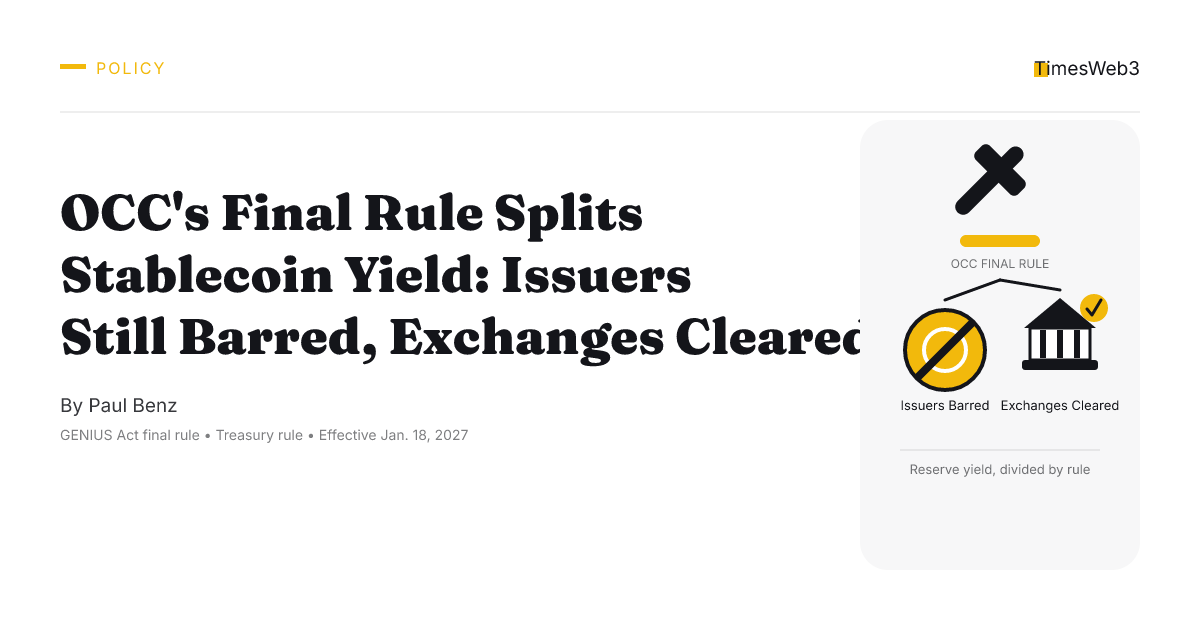
The split is specific: issuers themselves remain barred from paying interest directly, but the exchanges and platforms that hold customer stablecoin balances can now share reserve income with those customers. That distinction, issuer-level interest closed, platform-level reward sharing opened, is the operative line separating what USDC and USDT can offer through their own channels from what Coinbase, Kraken and similar venues can offer on top of them.
Key Takeaways
- The OCC finalized its GENIUS Act stablecoin rule covering reserves, redemption, risk management, audits and issuer applications, effective January 18, 2027.
- A companion Treasury rule, effective the same date, lets crypto exchanges share stablecoin reserve income with customers, while issuers like Circle and Tether stay barred from paying interest directly.
- The final rule dropped the “rebuttable presumption” standard from the earlier proposal, a shift the Blockchain Association credited to industry comment and the American Bankers Association called a retreat from Congress’s intent.
- Existing U.S. issuers with substantially complete applications pending by the effective date can request waivers from the OCC’s prior-approval requirement, which the agency generally expects to grant.
- AML, Bank Secrecy Act and sanctions provisions were carved out for separate rulemaking with Treasury, and the OCC has not yet opened the application window.
What the Final Rule Actually Covers
The OCC’s rule sets reserve, redemption, risk-management, audit, reporting, supervision, custody and capital standards for payment stablecoin issuers under its jurisdiction, according to TokenPost. Permitted issuers must hold identifiable reserve assets worth at least 1:1 against outstanding stablecoins, with eligible assets limited to cash, demand deposits, certain Treasury securities, specified repurchase agreements and qualifying government money market funds. Anti-money laundering, Bank Secrecy Act and sanctions requirements were carved out for a separate rulemaking the OCC will conduct with Treasury.
The agency has not opened applications yet. It plans to begin accepting them once the Office of Management and Budget approves the related information collection, then announce the opening separately, per TokenPost. That procedural step means the January 18, 2027 effective date does not, on its own, force issuers out of the market: existing U.S. issuers with substantially complete applications already pending by then can request waivers from the prior-approval requirement, and the OCC generally expects to grant them absent stronger grounds to deny.
The Yield Fight the Rule Reopened
The Treasury-side rule on reserve income sharing reignited a fight banking groups thought they had won. According to Roll Call, the GENIUS Act barred issuers like Circle and Tether from offering interest or rewards as an enticement, but left room for third-party intermediaries, chiefly exchanges, to offer yield-bearing options. The earlier proposed rule had maintained a general ban on such arrangements while giving industry a “rebuttable presumption” opportunity to argue an activity didn’t violate the law. The final rule dropped that presumption standard entirely, a change Roll Call reported was industry-backed.
The reaction split along predictable lines. American Bankers Association President and CEO Rob Nichols said the rule “will preserve the status quo for crypto platforms despite Congress’s clear intent to protect local lending,” calling it a departure from the OCC’s original position on stablecoin yield, per Roll Call. Blockchain Association chief policy officer Lindsay Fraser took the opposite view, saying the group is “especially grateful that the OCC listened to the industry” and that the final text reflects changes its members suggested during the comment period. Davis Wright Tremaine partner Steve Gannon told Roll Call the rule should make it easier for issuers to justify indirectly offered yield, adding that if an issuer can’t articulate that justification, “maybe they shouldn’t be paying yield.”
Experts cited by Roll Call pointed to one likely eligible activity under the case-by-case standard: participation in liquidity pools on platforms like Uniswap, where stablecoin deposits earn trading fees rather than direct interest. The OCC did not publish a specific list of allowable use cases, leaving that determination to individual review.
Why USDC and USDT Both Have a Stake
The rule package matters most for the largest stablecoin issuers and the exchanges that hold their tokens, since reserve balances generate the income now eligible for sharing. Banking trade groups have warned the decision could trigger deposit outflows from banks into stablecoin accounts and weaken lending capacity, a concern Nichols reiterated in his statement. That objection remains a forecast rather than an observed outcome: no stablecoin supply data cited in the coverage so far shows a shift attributable to the rule itself.
What to Watch
The next concrete marker is procedural rather than market-driven. The OCC must wait for OMB approval of its information collection before it can open the issuer application window, and it has not set a date for that announcement. Separately, the companion AML, Bank Secrecy Act and sanctions rulemaking with Treasury has no publication timeline yet, and both the primary rules take effect January 18, 2027, the same date Congress set when it enacted the GENIUS Act on July 18, 2025.