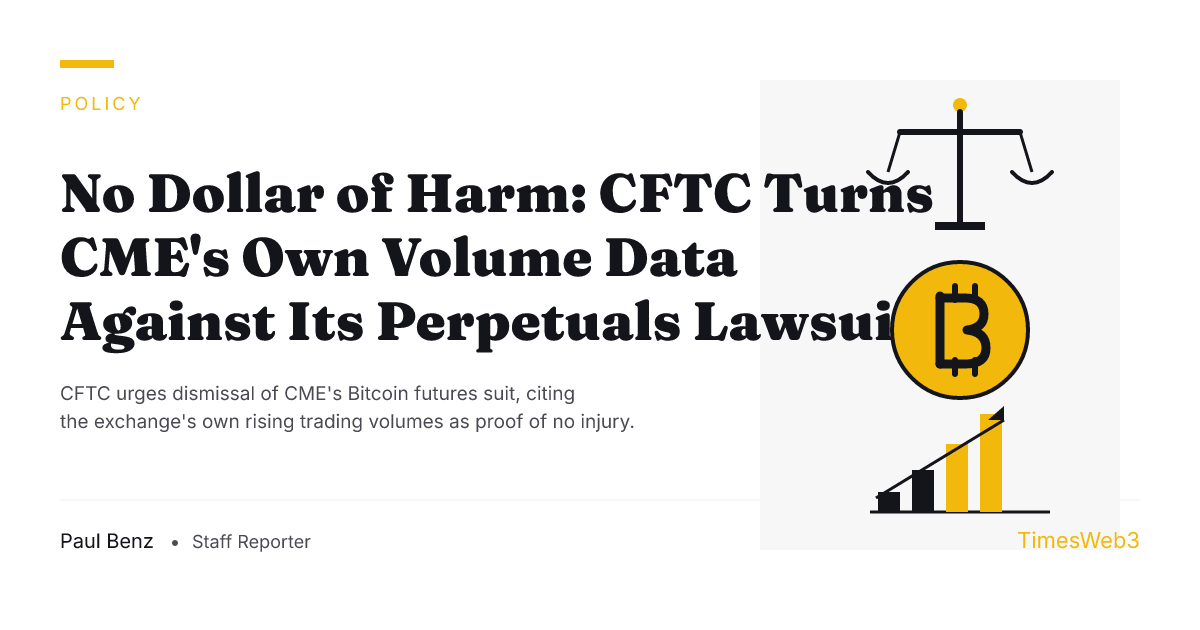
The fight over who gets to list Bitcoin perpetual futures in the United States now turns on a narrower legal question: whether CME Group was actually hurt by a rival’s product. In a reply brief filed in the U.S. District Court for the District of Columbia, the Commodity Futures Trading Commission told the court that CME cannot show it was, and asked the judge to throw the case out before reaching the underlying dispute over how perpetuals should be classified, according to CoinMarketCap.
That distinction matters because it could decide the case without ever resolving what started it: whether a contract with no expiration date is a “future” or a “swap” under the Commodity Exchange Act. If the court agrees CME lacks standing, the CFTC’s May approval of the first U.S.-regulated Bitcoin perpetual contract stays in place, and the classification question goes unanswered, according to The Token Press.
Key Takeaways
- The CFTC filed its reply on October 16, arguing CME has not shown “a dollar of harm” from the agency’s approval of Bitcoin perpetual futures, according to CoinMarketCap.
- CME’s own reported Bitcoin futures volume rose from 259,329 contracts in May to 267,693 in September; Ethereum futures volume rose from 326,981 to 378,292 over the same period.
- CME’s CEO said in July that the exchange has “full technical and operational capabilities” to launch its own perpetuals but has not, citing a lack of customer demand.
- The case, Chicago Mercantile Exchange Inc. v. Selig, concerns the CFTC’s May 29 approval of Kalshi’s BTCPERP contract, the first U.S.-regulated Bitcoin perpetual futures product.
- Judge Colleen Kollar-Kotelly has not ruled on dismissal and already denied the CFTC’s request for limited discovery into CME’s standing in September.
What the CFTC Told the Court
The agency’s core argument is procedural, not substantive: CME has not met the bar for standing to sue. The CFTC’s 31-page reply, filed Friday, states plainly that “when a plaintiff cannot identify a dollar of harm, much less explain how the requested relief would remedy that non-existent harm, its case does not belong in a federal court,” according to CoinMarketCap. The Token Press frames the same filing slightly differently, describing it as the CFTC arguing CME has shown no “actual or imminent competitive injury” sufficient to keep the suit in court, rather than disputing the harm outright, according to The Token Press.
The CFTC also pushed back on what CME is asking for even if it did have standing. CME wants perpetual futures reclassified as swaps rather than futures. The agency argued that reclassification would not change where the products trade, since both futures and swaps are listed on designated contract markets: “Reclassifying perpetuals from ‘futures’ to ‘swaps’ would not remove them from DCMs any more than reclassifying a movie from ‘action’ to ‘thriller’ would remove it from a streaming platform,” the brief said, per CoinMarketCap. Separately, the agency argued CME’s claim falls outside the “zone of interests” the Commodity Exchange Act is meant to protect.
The Numbers CME Now Has to Explain
CME’s own trading data is doing most of the work for the CFTC. According to figures cited in the agency’s filing and reported by CoinMarketCap, CME’s monthly Bitcoin futures volume climbed from 259,329 contracts in May, the month the CFTC approved Kalshi’s perpetual, to 267,693 in September. Ethereum futures volume rose from 326,981 to 378,292 over the same stretch. Crypto Briefing separately reported that CME’s Bitcoin futures hit 298,958 contracts in August, a 15.3% increase from May.
The agency paired that data with CME’s own public statements. Its CEO said in July, when the exchange reported second-quarter results, that CME has “the full technical and operational capabilities to launch perpetual futures” but has chosen not to because “we have not heard demand from our customers for these products,” according to CoinMarketCap. The CEO also said perpetuals “may appeal to certain retail traders,” while Crypto Briefing notes CME executives told the CFTC on July 22 that institutional clients had shown no demand for the product. CME’s volume is 94% institutional in the first half of 2026, per the CFTC’s filing.
How the Case Got Here
CME sued in June, challenging both the CFTC’s May 29 order approving Kalshi’s BTCPERP contract and the policy statement allowing any designated contract market, including CME itself, to list perpetual futures on digital assets, according to Crypto Briefing. The CFTC moved to dismiss in September on standing grounds and for failure to state a claim. That same month, the Hyperliquid Policy Center filed a brief backing the agency, urging the court to grant the CFTC’s motion to dismiss, per CoinMarketCap. Judge Kollar-Kotelly also denied the CFTC’s request for limited discovery into CME’s standing in September, a procedural ruling that left the standing question for argument on the existing record.
What to Watch
The reply brief is advocacy, not a ruling. Judge Kollar-Kotelly still has to weigh both the standing question and the CFTC’s other grounds for dismissal, and The Token Press reports no final timetable has been stated in the public docket. If the court dismisses on standing, the May order and policy statement remain in force without the classification question ever being tested. If the case proceeds, the broader question of whether perpetual contracts count as futures or swaps under the Commodity Exchange Act would get a fuller hearing, something that could shape how other U.S. exchanges approach listing similar products.
Sources
- CoinDesk: U.S. CFTC rebuffs CME legal stance in consequential fight over perpetual futures
- CoinMarketCap: CFTC Presses Court to Toss CME’s Crypto Perpetual Futures Suit
- Crypto Briefing: CFTC cites CME data to argue against challenge to perpetual futures
- The Token Press: CFTC Challenges CME’s Standing in U.S. Perpetual-Futures Case